Showing posts with label Loulou. Show all posts

Tuesday, September 1, 2026

Louise Brooks Retrospective at La cinémathèque française

La cinémathèque française in Paris is mounting a major retrospective of the films of Louise Brooks which is set to take place later this month, from September 17 through September 24. The 10 program series will feature 9 of the actress's feature films, along with a 10th program featuring the surviving fragments from three of Brooks' other films. There is, as well, a 60 minute discussion about Brooks with Professor Marion Polirsztok, moderated by Marién Gómez of the Cinémathèque françaiseMore about this event, including times, venues, and ticket availability, can be found HERE.

Notably, this is the first retrospective of Brooks' films since the recent preservation of four of the actress' surviving / fragmentary films, each of which was included on the 2026 release Focus on Louise Brooks, from Flicker Alley. AND, for at least a couple three of these films, it will mark their first showing in Paris in 99 or 100 years!

The brief introductory statement says, in translation, "One of the legendary figures of 1920s cinema, celebrated as much for her modern acting style as for her scandalous aura—the ultimate embodiment of the freedom and avant-garde spirit of the Roaring Twenties. Once a Hollywood queen and a shooting star of European cinema (*Diary of a Lost Girl*, *Pandora's Box*), she reinvented herself as a writer before fading into obscurity on the eve of World War II—until Henri Langlois resurrected the fallen star in 1955, opening his tribute at the Cinémathèque Française with the definitive declaration: 'There is no Garbo, there is no Dietrich: there is only Louise Brooks!'"


Appropriately, the retrospective's overture screening is the restored sound version of Prix de beauté. (Too bad they are not showing the silent version as well, as a coda.) The retrospective concludes with a three film program of the aforementioned three film fragments from Focus on Louise Brooks. Otherwise, here is the schedule of films: the descriptive text comes from the La cinémathèque française website, and is given in English translation.

September 17

Prix de beauté
Augusto Genina 
France / 1930 / 99 min / DCP / Restored version 
With Louise Brooks, Georges Charlia, Henri Bandini.
A young typist wins a beauty contest that sparks jealousy and desire. Originally written by René Clair and directed by Augusto Genina, *Prix de beauté* bears the fascinating traces of the transition from silent to sound film, blending silence, voices, and a sense of melancholic modernity.
 
"She represents the intelligence of screen acting; she is the perfect embodiment of photogenie; she alone encapsulates everything the cinema of the late silent era sought: extreme naturalness and extreme simplicity. Her art is so pure that it becomes invisible." (Henri Langlois)

September 18


It's the Old Army Game

A. Edward Sutherland
USA / 1926 / 70 min / 35mm unique print / French intertitles
Based on the play *The Comic Supplement* by J. P. McEvoy and W. C. Fields.
With W. C. Fields, Louise Brooks, Blanche Ring. 
Musical accompaniment by Arno Dedeycker.
 
A pharmacist sees his daily life descend into chaos as he deals with a parade of intrusive customers and passing con artists. Drawing on W. C. Fields’s vaudeville routines, the film offers a mischievous tale filled with gags and absurd situations, all illuminated by the singular presence of Louise Brooks. A slapstick whirlwind that is as chaotic as it is delightful.
 
The Street of Forgotten Men
Herbert Brenon
USA / 1925 / 75 min / DCP / French intertitles
With Percy Marmont, Mary Brian, Neil Hamilton.
 
In the Bowery, a con man lives by his wits and pretenses—until a young woman he has protected finds herself in danger. Herbert Brenon grounds his story in an urban setting rich in colorful detail and, amidst the deceptions, sketches a path toward possible redemption. It also marks the debut of Louise Brooks as a spirited companion.
 

September 19

A Girl in Every Port
Howard Hawks
USA / 1928 / 77 min / 35mm / French intertitles
With Victor McLaglen, Robert Armstrong, Louise Brooks.
Musical accompaniment by Medhi Telhaoui

Working from a screenplay he wrote himself, Howard Hawks directs Robert Armstrong and Victor McLaglen in a comedy about male friendship strained by the opposite sex. Underlying the story is the ambiguous relationship between two men—a theme Hawks would revisit repeatedly throughout his career. Opposite them—and calling the shots for a time—is Louise Brooks, on loan from Paramount for the occasion. Hawks chose this "pretty, rebellious girl" for her looks and determination. She brings an avant-garde edge to the film, and her role as a "bad girl" caught the eye of Pabst, who saw in her his future *Lulu*. *A Girl in Every Port* is "conceived in the present yet identifies with the past," notes Henri Langlois. It is a melodrama tinged with humor—resolutely modern and, for Hawks, seminal. Also known by the title *Poings de fer, cœur d'or* (Iron Fists, Heart of Gold). 

Discussion with Marion Polirsztok
Moderated by Marién Gómez 60 min
It is generally understood that Louise Brooks’s life and career were profoundly shaped by the two German films she made with Pabst. "In Berlin," she wrote, "I became an actress."
But what was she in Hollywood? An "anti-star," as the 1977 book dedicated to her suggests? Revisiting *A Girl in Every Port* offers a chance to rediscover Louise *before* Lulu—to see the image, the roles, and the femininity she embodied within the American film industry of the late 1920s. —  Marion Polirsztok Marion Polirsztok is an Associate Professor of Film Studies at Rennes 2 University. Marién Gómez is a Cultural Activities Coordinator at the Cinémathèque française.

Beggars of Life
William A. Wellman
USA / 1928 / 82 min / DCP / French intertitles / Restored version
Based on the novel *Apache Rising* by Julian Johnson. *Beggars of Life* by Jim Tully.
Starring Wallace Beery, Richard Arlen, Louise Brooks.
Screening presented by Marion Polirsztok. Musical accompaniment by Kolia Chabanier

After killing her attacker, an orphan girl hits the road across the Midwest with a charming drifter.
They become entangled with a band of stowaways led by the fearsome Oklahoma Red. Adapted from the novel by Jim Tully—a literary classic chronicling the hobos who secretly rode freight trains—this is a raw, realistic slice-of-life portrait of the vagrants of the 1890s recession. Beyond Wellman’s masterful direction, the film—released a year before the 1929 crash—derives its power from its cast (featuring real-life drifters) and a deeply moving Louise Brooks in one of her finest roles.

LoulouDie Büchse der Pandora
Georg Wilhelm Pabst
Germany / 1929 / 134 min / DCP / French intertitles / Restored version
Based on the plays *Pandora's Box* (*Die Büchse der Pandora*) and *Earth Spirit* (*Erdgeist*) by Frank Wedekind.
With Louise Brooks, Fritz Kortner, Franz Lederer, Carl Goetz.

Refusing to bow to the social conventions that seek to confine her, Lulu moves through various social circles and desires, living for passion and pleasure. Drawing on Frank Wedekind’s plays, Pabst crafts a lucid tragedy—a dance of love and death—that exposes the hypocrisies of a society obsessed with controlling the body. A blend of innocence and sensuality, Louise Brooks’s modern performance—with her bobbed hair and intense gaze—elevates a masterpiece of latent eroticism, where fascination and destruction go hand in hand, cementing the birth of an enduring cinematic icon.

"No one captured the feverish atmosphere backstage on the opening night of a grand revue quite like Pabst: the dizzying haste, the seemingly aimless coming and going, the press of bodies as sets are shifted about, the stage seeming to tilt askew during the acts, the entrances and exits, the performers’ eagerness to take their bows amidst the applause, the rivalry, the camaraderie, and the humor—that bewildering mix of prop men and electricians at work, artistic aspiration, colorful spectacle, and easy sensuality. A dazzling display, a heated atmosphere, and sensuality awash in waves of light—shimmering on lamé curtains, gleaming on helmets and armor, and casting a pearly glow over the bodies of near-naked women." "Everything wavers in the hazy background where Loulou appears as a kind of pagan idol—alluring, glittering with sequins, feathers, frills, and furbelows." (Lotte Eisner)

September 20

Le Journal d'une fille perdue / Tagebuch einer Verlorenen
Georg Wilhelm Pabst
Germany / 1929 / 95 min / DCP / French intertitles / Restored version
Based on the novel *Tagebuch einer Verlorenen* by Margarete Böhme.

With Louise Brooks, Sybille Schmitz, Edith Meinhard.
Screening introduced by Florence Tissot

Cast out by her family, seduced and then rejected, a young woman endures the brutality of institutions, moving from a boarding school to a brothel. Louise Brooks’s elusive gaze haunts this indictment of the moral order, elevated by Pabst’s poetic realism. A hymn to forgiveness and generosity.

"Louise Brooks represents the intelligence of screen acting; she is the perfect embodiment of photogenie. She alone encapsulates everything the cinema of the late silent era sought: extreme naturalness and extreme simplicity. Without her, Pabst could never have achieved universality; he could never have attained that direct, stripped-down, objective style; he could never have gone so far, handling such risqué subjects with such elegance—that way of saying everything, analyzing everything, without seeming to touch it." (Henri Langlois)

The Canary Murder Case
Malcolm St. Clair, Frank Tuttle
USA / 1929 / 82 min / 35mm (unique print) / Original version with French subtitles
Based on the novel *The Canary Murder Case* by S. S. Van Dine.

Starring William Powell, James Hall, Louise Brooks.

A cabaret singer—a past master at the art of blackmail—is found dead. Surrounding her is a gallery of compromised men, all suspects and all manipulated. A product of the Pre-Code era, *The Canary Murder Case* plunges into a world of mercenary seduction and deceptive appearances, where scandal is the common currency. A poisonous mystery and a scathing portrait of the nightlife scene.

September 24

The Show Off 
Malcolm St. Clair
USA / 1926 / 75 min / 35mm unique print / 
French intertitles
With Ford Sterling, Lois Wilson, Louise Brooks.

An inveterate braggart insinuates himself into a respectable family, making promises he cannot possibly keep. Ford Sterling delivers a performance of unbridled bluster, mirroring a social veneer cracked by constant lying and chatter. It is a biting comedy that turns absurdity into a driving force and the loudmouth into a true agent of chaos.

The American Venus
Frank Tuttle
USA / 1925 / 8 min / DCP / French intertitles / Restored version
With Esther Ralston, Lawrence Gray, Louise Brooks.

Beauty pageants, advertising, and dreams of stardom provide the backdrop for a comedy set in the heart of 1920s America. Through the already captivating figure of Louise Brooks in her first major role, Tuttle captures the emergence of a form of femininity that is exposed and mediated—featuring actual footage from the Miss America pageant—and held captive by a spectacle that shapes bodies and images.
 

Now We're in the Air
Frank R. Strayer
USA / 1927 / 23 min / 
DCP / French intertitles / Restored version
Starring Louise Brooks, Wallace Beery, and Raymond Hatton.

Amidst espionage and cases of mistaken identity, two bumbling aviators find themselves swept up in the war.
Driven by the comic duo of Wallace Beery and Raymond Hatton, this third installment in a series of military comedies favors slapstick and adventure. Louise Brooks plays mischievous twins, bringing charm and levity to a fast-paced, whimsical film punctuated by spectacular aerial sequences borrowed from William Wellman’s *Wings*.

Just Another Blonde
Alfred Santell
USA / 1926 / 32 min / 
French intertitles / Restored version
Starring Dorothy Mackaill, Jack Mulhall, Louise Brooks.

A New York player must woo the woman he loves on behalf of his best friend.
At Coney Island, charm is a weapon, promises are traded like chips, and hearts fall faster than illusions. Shot on location, *Just Another Blonde* turns the pursuit of success into a lively, cheeky game of deception where everyone tries their luck—even if it means cheating a little.
 

Be sure and check out the adjunct pages linked to from the main retrospective page, including the letter from Louise Brooks to Henri Langlois, and Élodie Tamayo's essay, "The Art of Punctuation," which begins with the brilliant opening line, "What if Louise Brooks were a punctuation mark?"

Find out more about four of the films in this historic retrospective by checking out one or more of these publications from Thomas Gladysz and the Louise Brooks Society, all of which are available from amazon France.


Beggars of Life: A Companion to the 1928 Film, by Thomas Gladysz (with a foreword by William Wellman Jr.) 

Now We're in the Air: A Companion to the Once "Lost" Film, by Thomas Gladysz (with a foreword by Robert Byrne)

The Street of Forgotten Men: From Story to Screen and Beyond, by Thomas Gladysz (with forewords by Robert Byrne & Kevin Brownlow)

Louise Brooks, the Persistent Star, by Thomas Gladysz

The Diary of a Lost Girl (Louise Brooks edition), by Margarete Bohme (edited & with an introduction by Thomas Gladysz)

THE LEGAL STUFF: The Louise Brooks Society™ blog is authored by Thomas Gladysz, Director of the Louise Brooks Society  (www.pandorasbox.com). Original content copyright © 2026. Further unauthorized use prohibited. As an Amazon Associate, I earn from qualifying purchases. 

Wednesday, October 18, 2023

Loulou (aka Pandora's Box) airs on French television tonight

Loulou (aka Pandora's Box) will be shown on French television tonight at 8:50 pm on the Ciné+ Classic station. An article in L'Obs describes the film as "One of the most legendary films in the history of cinema." The article goes on to state (in translation) "Louise Brooks, who plays the main role, has become the very symbol of evil beauty, devastating sexuality and, thanks to her (unusual) physique, the most toxic passion." The L'Obs article, « Loulou », naissance d’une femme fatale, can be found HERE

Curiously, the article describes Brooks hairstyle as a "pixie haircut," and also claims that the Nazi's "burned" the film. I think they might mean censored. Here is an old French advert for the film.


If you don't live in France or can't catch the film on television, take note that the film will released on Blu-ray in the UK at the end of the month. This forthcoming release is part of the Masters of Cinema series from Eureka. More information can be found HERE.


THE LEGAL STUFF: The Louise Brooks Society™ blog is authored by Thomas Gladysz, Director of the Louise Brooks Society  (www.pandorasbox.com). Original contents copyright © 2023. Further unauthorized use prohibited. As an Amazon Associate, I earn from qualifying purchases.


Monday, October 31, 2022

A Halloween post - an almost scary Louise Brooks

As most everyone agrees, Louise Brooks was a beautiful women. She was lovely, and it is hard to imagine a depiction of the actress which might depict her so poorly as to make her almost unrecognizable, even a bit "scary." And yet, there exists just such a depiction. As best I can tell, this poster dates from 1930, and comes from France. It is a poster for Loulou, the French title of Pandora's Box. The artist is Marcel Gaillard. (I couldn't find much else about him.)

The scene shown on the poster above comes from Pandora's Box, at the moment when Alwa places his head in the lap of Lulu. If one has seen the film, then one knows this scene. Yet, the poster artist has so clumsily rendered Brooks' face as to make her unappealing, almost "ugly - I am not sure what other word to use. This is, in my opinion, one of the worst depictions of Brooks, at least, one of the worst I have ever seen.

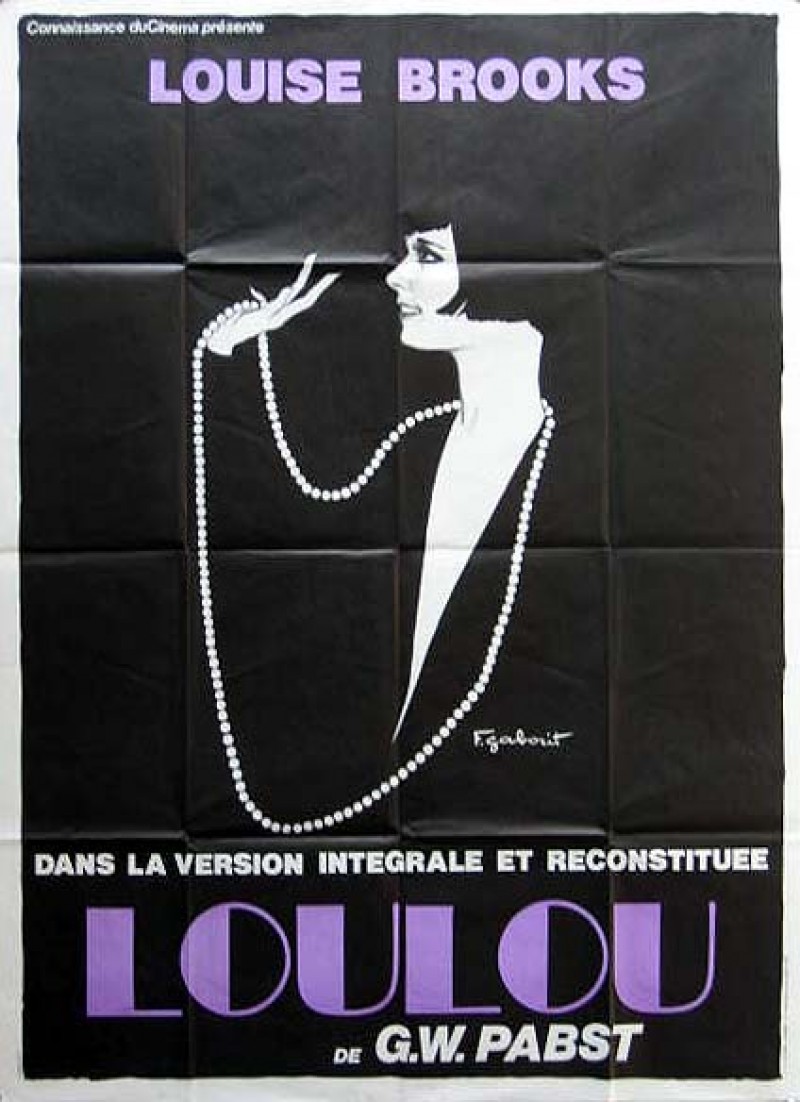
Another clumsy depiction of Brooks also comes from France. This one is by F. Gaboit, and it adorned a 1980 poster for Loulou issued by Connaissance duCinema (as shown below). Based on the famous Eugene R. Richee photographic portrait of Brooks, this illustration also falls short, especially in the way the artist has elongated the fingers which hold the strand of pearls. There is also something about the way Gaboit has rendered Brooks' face that doesn't appeal to me. I can't say what exactly, but that is the way I feel. Maybe it is because Richee's portrait is so perfect, and that this drawn illustration is so imperfect. I have seen another adaption of this poster art, and it is similarly lacking.

Gaboit was not a bad artist, it is just that I think the Loulou poster falls short. On the other hand, Gaboit's poster for Le Journal d'une fille perdue (the French title for Diary of a Lost Girl) is appealing and I think successful in capturing the lovely allure of Brooks.

 
The Louise Brooks Society blog is authored by Thomas Gladysz, Director of the Louise Brooks Society. (www.pandorasbox.com). Original contents copyright © 2022. Further unauthorized use prohibited.

Wednesday, October 12, 2022

Loulou opens Synchro film music festival at Cinémathèque de Toulouse

The 1929 Louise Brooks film, Loulou (otherwise known as Pandora's Box) will open the Cinémathèque de Toulouse Synchro, a film music festival running from November 30 to December 4. More information HERE.

Louise Brooks not only opens the new festival, she also adorns its inaugural poster. With Synchro, the Cinémathèque de Toulouse hopes to establish a week long series of cinema concert events which not only celebrate the silent era but also give it a beat. Each film concert will feature an original score ranging from classical to jazz through rock and electronic music, "introducing the widest possible audience to films from a new angle and giving them unique experiences with musicians who will play live, sometimes in unexpected places."

Approximately 30 film concerts are set to take place during this first event. Among them are these three highlights: 

Cinema icon Louise Brooks will light up the opening of SYNCHRO, with Loulou (1929) by George Wilhelm Pabst. This German cinematic masterpiece will be accompanied by two composers who specialize in accompaniment to silent films who have appeared in many festivals around the world: Dutch pianist Maud Nielsen and Portuguese bassist Eduardo Raun. - Wednesday, November 30 at the Cinémathèque de Toulouse.

A monument in the history of cinema included at SYNCHRO, The Man with a Camera filmed and directed in Odessa, Ukraine in 1929 by Soviet director Dziga Vertov. This documentary, famous for its exceptional editing, will be accompanied by a composition by Pierre Henri, the founding father of electro-acoustic music. Ole acousmonium and Maylis Raynal will provide the electroacoustic broadcast. - Thursday, December 1 at Cinémathèque de Toulouse.

Considered one of the best films ever made, The Gold Rush (1925) by Charlie Chaplin will be accompanied by the Orchester National du Capitole de Toulouse, led by Timothy Brock. This American composer, musician, and specialist in restoring silent film soundtracks has been working since 1999 to restore the Chaplin family’s musical scores. - Friday 25 and Sunday 27 December in Halle aux Grains (Toulouse), Saturday 26 December in Aria (Cornebarrieu).

More information and reservations: www.lacinemathequedetoulouse.com

This blog is authored by Thomas Gladysz, Director of the Louise Brooks Society (www.pandorasbox.com). Original contents copyright © 2022. Further use prohibited.

Sunday, June 20, 2021

G. W. Pabst gripes about censorship of his two Louise Brooks films

While looking through Parisian newspapers while working on Around the World with Louise Brooks (my forthcoming two volume transnational look at Brooks' career), I came across a couple of noteworthy interviews with director G. W. Pabst. In one of them (the second piece, shown below), he complained about French censorship of his films, including the two films he made with Louise Brooks. 

The occasion for Pabst's complaint was his visit to Paris in January 1931, which prompted a few Parisian newspapers to profile and interview the Austrian-born director.  The article pictured to the right was published in Comœdia on January 30, 1931.

Why were French journalists interested in Pabst? At this point in his career, there were few directors as esteemed by French critics than Pabst. His silent and early sound films were highly regarded, especially Joyless Street (1925), The Love of Jeanne Ney (1927), Loulou / Pandora's Box (1929), Diary of a Lost Girl (1929), and Westfront 1918 (1930). Despite the high regard in which they were held, French censors still excised so much of Pabst's two Brooks' films that it annoyed both the director and French critics, who complained time and again about the sorry state of each film. (I have run across a number of articles about the two Brooks' films in which newspaper and magazine writers said they were aware each film had been cut.)

In France, Pandora's Box went under the titles Le Boite de Pandore, or Loulou, while The Diary of a Lost Girl went under the title Le Journal d'une Fille perdue and Trois pages d’un journal. The latter was a huge success, showing continuously for more than a month after debuting in Paris. (This was at a time when most films showed for only a week.)

I won't translate the entire article pictured left; it appeared in Le Quotidien on February 6, 1931 and takes the form of a profile, within which are interspersed Pabst's answers to various questions asked by "L.D.", the author of the piece.

The article begins by stating that everyone was pleased that the acclaimed director was in Paris, where he was considering taking on the direction of a French film.

The second to last paragraph is of special interest. In translation, it reads: "I have never been lucky in France with my films. None escaped the censor's chisel. Two of my films: The Diary of a Lost Girl and Pandora's Box (Loulou) have been altered in their fundamental meaning. Even in Germany I was not immune from such severity; thus The Diary of a Lost Girl was cut by nearly three hundred meters, all in small pieces. But at least the meaning of the film remained the same."

The article concludes, "There is no bitterness in Pabst's voice. He is no longer fixed on the past. He stretches his strength and his heart towards the next work which will be a great humane film. Ten minutes later he jumps on the train which brings him back to Berlin."

To me, Pabst's comments are revealing. It had been well more than a year that both of his Brooks's had shown in Paris, and even longer since their German debut. Yet, they were still on his mind, or on the mind of French journalists.

Does anyone know if French censorship records still exist, or or accessible?


Tuesday, February 4, 2020

New G.W. Pabst DVD Blu-ray set features Louise Brooks

A new 16 disc set featuring the films of the Austrian-born German director G.W. Pabst has been released in France. And what's more, this gorgeous looking box set features Louise Brooks on the cover.
The set, released by Tamasa Diffusion and titled G.W. Pabst-Le Mystère d'une Âme, features 12 of the acclaimed director's best films, including Joyless Street (1925) and The Loves of Jeanne Ney (1927) as well as The White Hell of Pitz Palu (1929), The Three Penny Opera (1931), and Kameradschaft (1931). And of course, there is also Pandora's Box (1929) and The Diary of a Lost Girl (1929). The set, which runs 1289 minutes, focuses on Pabst's early efforts, but regrettably omits Secrets of a Soul (1926). Likewise, it includes Don Quixote (1933), but omits L'Atlantide (1932).

The set proclaims: "witnesses of his mastery of staging and his permanent inventiveness." The more than three and one-half hours of bonus material scattered over the various discs includes short documentary presentations, alternative versions, archival material and more. A bonus disc includes the 60 minute documentary Looking for Lulu. Also included is a 132 page book, Imaginary correspondence with Georg Wilhelm Pabst, written by Pierre Eisenreich.

I haven't yet seen this recently released set, but hope to acquire a copy soon. I need to save up my Euros! As of now, G.W. Pabst-Le Mystère d'une Âme seems only to be available via amazon France or directly (and at a better price) from its distributor, Tamasa.

Monday, September 30, 2019

Louise Brooks in second edition of Perfume Legends

Fragrance expert Michael Edwards has revised and updated his highly regarded reference work Perfume Legends. First published in 1996, Edwards' book is now considered one of the most significant books written on modern perfumery. His new book, Perfume Legends II, has recently been released, and includes a reference to Louise Brooks in describing Loulou, a Louise Brooks-inspired  scent created by Jean Guichard for Cacharel in 1987. (A container of this perfume, in its box, is in the collection of the Louise Brooks Society.) The Loulou perfume is also depicted on the cover of the book.


The following two paragraphs are excerpted from Perfume Legends II. "By the mid-eighties, competition in the French fragrance market had become brutal. In just one year, more fragrances were launched than in the entire 1960s. Loulou was a sequel to 1978’s Anaïs Anaïs and inspired by silent film star Louise Brooks. 'In France, people say that a young girl’s skin smells of caramel. That is the smell of toffee,' says Guichard. 'So we started working around the vanilla-toffee notes.'

In Tahiti he came across the beautiful tiare flower, which had a freshness he needed to balance the 'gourmand' flavours. 'We associate vanilla with something very agreeable, because, as children, we were spoiled by cakes and ice cream. More than that, it’s a scent that men find sexy'."


It is interesting to note that the script font used to spell out the word Loulou is the same used on the Dutch edition of Loulou in Hollywood.

SUPPORT the LOUISE BROOKS SOCIETY via PAYPAL

Powered By Blogger