Showing posts with label It Pays to Advertise. Show all posts

Saturday, February 28, 2026

It Pays to Advertise, with Louise Brooks in a cameo, was released on this day in 1931

It Pays to Advertise, with Louise Brooks, was released on this day in 1931. The film is a farce about rival soap companies, an advertising agency, and a ne’er do-well playboy who attempts to make good. Louise Brooks plays Thelma Temple, a dancer appearing in a musical entitled Girlies Don’t Tell. Brooks’ part in the film, done to fulfill her contract with Paramount, amounted to little more than a cameo. The Hollywood Reporter wrote “Louise Brooks flashes in and out of the opening scenes and looks like a good bet for bigger roles.” Due to tepid reviews and negative publicity, It Pays to Advertise did poorly at the box office. At best, most exhibitors reported only fair business. In Los Angeles, according to one report, the film “set a new low.” The film failed to do much for Brooks’ sputtering career.

More about the film can be found on the newly revised Louise Brooks Society filmography page

Production on the film took place in and around Los Angeles in late 1930. It Pays to Advertise was based on a popular stage play from 1914. In 1931, reviewers commented that the story was old-fashioned – despite the fact that Paramount attempted to update its scenario through the use of new scenes, art deco sets, snappy dialogue, and a fast-moving script.

The film received few positive reviews. Photoplay wrote that it has “plenty of speed and lots of laughs”, while praising the “perfect cast”. Variety wrote “Subject to the limitation of all screen farces, this revamped stage frolic makes good enough program material with only moderate prospects at the box office.” New York’s The World, however, called it “pretty dreary.” The New Yorker stated “Among the dull pictures of the week we might list that old relic, It Pays to Advertise, which is full of smart-aleck cracks and is altogether a bore.”

The film starred Norman Foster, then husband of Claudette Colbert, and Carol Lombard, who was at the beginning of her film career. The gravel-voiced Eugene Pallette played the soap king; he had also played a supporting role in Brooks’ previous American film, The Canary Murder Case. The fast talking Skeets Gallagher played the wisecracking publicist – then called press agents. Brooks received fifth billing, and was largely left off promotional materials supplied by the studio.

Few publications mentioned Brooks, except to mention her brief appearance. Some publications noted that the role represented a comeback. The Kansas City Star commented, “Carole Lombard is pretty as the Mary Grayson in the cast, but Louise Brooks, who used to be quite a name in the photoplay world, is more attractive as the actress who does the airplane fall and is not seen thereafter.” Harry Evans, writing in Life magazine, stated “Louise Brooks, whom we have not seen on the screen since her momentary appearance in The Canary Murder Case (in which a voice double was used to speak her lines), seems to have been studying, as she gets away with her bit in this one creditably. Her real purpose in the film, however, is to show her legs, and in this phase of stage-craft she certainly needs no double.”

Set in the advertising and business world, It Pays to Advertise referenced a number of actual products and their slogans. As a result, one trade journal took exception to the practice. Harrison’s Reports, which billed itself “a reviewing service free from the influence of film advertising,” objected to product placement in film — be it verbal or visual. Over the course of four months (in articles titled “The Facts About Concealed Advertisements in Paramount Pictures,” “This Paper’s Further Efforts Against ‘Sponsored’ Screen Advertisements,” and “Other Papers That Have Joined the Harrison Crusade Against Unlabelled Screen Advertising”) editor P. S. Harrison railed against the business world farce in particular and product placement in films in general. “The Paramount picture, It Pays to Advertise, is nothing but a billboard of immense size. I have not been able to count all of the nationally advertised articles that are spoken of by the characters.” In the next issue, Harrison stated “In last week’s issue the disclosure was made that in It Pays to Advertise there are more than fifteen advertisements in addition to the main advertisement, ’13 Soap Unlucky for Dirt,’ which Paramount is accused of having created as a brand for the purpose of selling it.”

Taking the high moral ground, Harrison’s Reports spurred a campaign against “sponsored moving pictures – meaning pictures which contain concealed or open advertising of some one’s product.” Harrison wrote to the studios – and Harrison’s Reports noted that a handful responded with pledges to not include verbal or visual product placement. The crusading editor also wrote to more than 2,000 newspapers, and a number published articles and editorials decrying the practice. Among those papers that joined Harrison’s cause were four of the New York dailies, the Gannett chain, and scores of small town papers, as well as the Denver Post, Detroit Free Press, St. Louis Globe-Democrat, and Tulsa Tribune. The Christian Science Monitor added to the chorus of complaint when it remarked, “Paramount should have been well paid for the large slices of publicity for trade-marked products that are spread all through this artificial story.”


SOME THINGS ABOUT THE FILM YOU MAY NOT KNOW:

It Pays to Advertise was based on the play of the same name by Roi Cooper Megrue and Walter C. Hackett. It was first presented on the Broadway stage on September 8, 1914 at the Cohan Theatre, and ran for nearly a year. Thelma Temple, the character played by Louise Brooks, does not appear in the original play.

— A novelized version of the play, adapted by Samuel Field, was published in 1915. The book was also serialized in newspapers across the United States. 

— The play has been made into a film on four occasions: there was a silent film in 1919, directed by Donald Crisp; the talkie in 1931, directed by Frank Tuttle; and a Swedish adaptation in 1936, directed by Anders Henrikson. In 1932, Paramount produced French language version of the 1931 film: Paramount remade the film at their studio at Joinville, France under the title Criez-le sur les toits, directed by Karl Anton and starring Saint-Granier and Robert Burnier.

More about the film can be found on the newly revised Louise Brooks Society filmography page

THE LEGAL STUFF: The Louise Brooks Society™ blog is authored by Thomas Gladysz, Director of the Louise Brooks Society  (www.pandorasbox.com). Original content copyright © 2026. Further unauthorized use prohibited. As an Amazon Associate, I earn from qualifying purchases.   

Friday, February 28, 2025

It Pays to Advertise, with Louise Brooks (briefly), was released on this day in 1931

It Pays to Advertise, with Louise Brooks, was released on this day in 1931. The film is a farce about rival soap companies, an advertising agency, and a ne’er do-well playboy who attempts to make good. Louise Brooks plays Thelma Temple, a dancer appearing in a musical titled Girlies Don’t Tell

More about the film can be found on the newly revised Louise Brooks Society filmography page

Production on the film took place in and around Los Angeles in late 1930. Brooks’ part in the film, done to fulfill her contract with Paramount, amounted to little more than a cameo. The Hollywood Reporter wrote “Louise Brooks flashes in and out of the opening scenes and looks like a good bet for bigger roles.” Due to tepid reviews and negative publicity, It Pays to Advertise did poorly at the box office. At best, most exhibitors reported only fair business. In Los Angeles, according to one report, the film “set a new low.” The film also failed to do much for Brooks’ sputtering career.

It Pays to Advertise was based on a popular stage play from 1914. In 1931, reviewers commented that the story was old-fashioned – despite the fact that Paramount attempted to update its scenario through the use of new scenes, art deco sets, snappy dialogue, and a fast-moving script.

The film received few positive reviews. Photoplay wrote that it has “plenty of speed and lots of laughs”, while praising the “perfect cast”. Variety wrote “Subject to the limitation of all screen farces, this revamped stage frolic makes good enough program material with only moderate prospects at the box office.” New York’s The World, however, called it “pretty dreary.” The New Yorker stated “Among the dull pictures of the week we might list that old relic, It Pays to Advertise, which is full of smart-aleck cracks and is altogether a bore.”

The film starred Norman Foster, then husband of Claudette Colbert, and Carol Lombard, who was at the beginning of her film career. The gravel-voiced Eugene Pallette played the soap king; he had also played a supporting role in Brooks’ previous American film, The Canary Murder Case. The fast talking Skeets Gallagher played the wisecracking publicist – then called press agents. Brooks received fifth billing, and was largely left off promotional materials supplied by the studio.

Few publications mentioned Brooks, except to mention her brief appearance. Some publications noted that the role represented a comeback. The Kansas City Star commented, “Carole Lombard is pretty as the Mary Grayson in the cast, but Louise Brooks, who used to be quite a name in the photoplay world, is more attractive as the actress who does the airplane fall and is not seen thereafter.” Harry Evans, writing in Life magazine, stated “Louise Brooks, whom we have not seen on the screen since her momentary appearance in The Canary Murder Case (in which a voice double was used to speak her lines), seems to have been studying, as she gets away with her bit in this one creditably. Her real purpose in the film, however, is to show her legs, and in this phase of stage-craft she certainly needs no double.”

It Pays to Advertise was a b-film, and wasn't exhibited as much as other featured releases. Nevertheless, under its American title, documented screenings of the film took place in Australia (including Tasmania), British Malaysia (Singapore), Canada, China, France, Hong Kong, Ireland, Jamaica, The Netherlands, New Zealand, South Africa, and the United Kingdom (including England, Northern Ireland, and Scotland). In the United States, the film was also promoted under the title Vale a Pena Anunciar (Portuguese-language press). Elsewhere, It Pays to Advertise was shown under the title To platí, aby inzeroval (Czechoslovakia). 

SOME THINGS ABOUT THE FILM YOU MAY NOT KNOW:

It Pays to Advertise was based on the play of the same name by Roi Cooper Megrue and Walter C. Hackett. It was first presented on the Broadway stage on September 8, 1914 at the Cohan Theatre, and ran for nearly a year. Thelma Temple, the character played by Louise Brooks, does not appear in the original play.

—  Set in the advertising and business world, It Pays to Advertise referenced a number of actual products and their slogans. As a result, one trade journal took exception to the practice. Harrison’s Reports, which billed itself “a reviewing service free from the influence of film advertising,” objected to product placement in film — be it verbal or visual. Over the course of four months (in articles titled “The Facts About Concealed Advertisements in Paramount Pictures,” “This Paper’s Further Efforts Against ‘Sponsored’ Screen Advertisements,” and “Other Papers That Have Joined the Harrison Crusade Against Unlabelled Screen Advertising”) editor P. S. Harrison railed against the business world farce in particular and product placement in films in general. “The Paramount picture, It Pays to Advertise, is nothing but a billboard of immense size. I have not been able to count all of the nationally advertised articles that are spoken of by the characters.” In the next issue, Harrison stated “In last week’s issue the disclosure was made that in It Pays to Advertise there are more than fifteen advertisements in addition to the main advertisement, ’13 Soap Unlucky for Dirt,’ which Paramount is accused of having created as a brand for the purpose of selling it.”  Taking the high moral ground, Harrison’s Reports spurred a campaign against “sponsored moving pictures – meaning pictures which contain concealed or open advertising of some one’s product.” Harrison wrote to the studios – and Harrison’s Reports noted that a handful responded with pledges to not include verbal or visual product placement. The crusading editor also wrote to more than 2,000 newspapers, and a number published articles and editorials decrying the practice. Among those papers that joined Harrison’s cause were four of the New York dailies, the Gannett chain, and scores of small town papers, as well as the Denver Post, Detroit Free Press, St. Louis Globe-Democrat, and Tulsa Tribune. The Christian Science Monitor added to the chorus of complaint when it remarked, “Paramount should have been well paid for the large slices of publicity for trade-marked products that are spread all through this artificial story.”

— The play has been made into a film on four occasions: there was a silent film in 1919, directed by Donald Crisp; the talkie in 1931, directed by Frank Tuttle; and a Swedish adaptation in 1936, directed by Anders Henrikson. In 1932, Paramount produced French language version of the 1931 film: Paramount remade the film at their studio at Joinville, France under the title Criez-le sur les toits, directed by Karl Anton and starring Saint-Granier and Robert Burnier.

THE LEGAL STUFF: The Louise Brooks Society™ blog is authored by Thomas Gladysz, Director of the Louise Brooks Society  (www.pandorasbox.com). Original contents copyright © 2025. Further unauthorized use prohibited. As an Amazon Associate, I earn from qualifying purchases.   


Wednesday, February 28, 2024

It Pays to Advertise, with Louise Brooks, was released on this day in 1931

It Pays to Advertise, with Louise Brooks, was released on this day in 1931. The film is a farce about rival soap companies, an advertising agency, and a ne’er do-well playboy who attempts to make good. Louise Brooks plays Thelma Temple, a dancer appearing in a musical titled Girlies Don’t Tell. More about the film can be found on the Louise Brooks Society filmography page


Production on the film took place in and around Los Angeles in late 1930. Brooks’ part in the film, done to fulfill her contract with Paramount, amounted to little more than a cameo. The Hollywood Reporter wrote “Louise Brooks flashes in and out of the opening scenes and looks like a good bet for bigger roles.” Due to tepid reviews and negative publicity, It Pays to Advertise did poorly at the box office. At best, most exhibitors reported only fair business. In Los Angeles, according to one report, the film “set a new low.” The film also failed to do much for Brooks’ sputtering career.

It Pays to Advertise was based on a popular stage play from 1914. In 1931, reviewers commented that the story was old-fashioned – despite the fact that Paramount attempted to update its scenario through the use of new scenes, art deco sets, snappy dialogue, and a fast-moving script.

The film received few positive reviews. Photoplay wrote that it has “plenty of speed and lots of laughs”, while praising the “perfect cast”. Variety wrote “Subject to the limitation of all screen farces, this revamped stage frolic makes good enough program material with only moderate prospects at the box office.” New York’s The World, however, called it “pretty dreary.” The New Yorker stated “Among the dull pictures of the week we might list that old relic, It Pays to Advertise, which is full of smart-aleck cracks and is altogether a bore.”

The film starred Norman Foster, then husband of Claudette Colbert, and Carol Lombard, who was at the beginning of her film career. The gravel-voiced Eugene Pallette played the soap king; he had also played a supporting role in Brooks’ previous American film, The Canary Murder Case. The fast talking Skeets Gallagher played the wisecracking publicist – then called press agents. Brooks received fifth billing, and was largely left off promotional materials supplied by the studio.

Few publications mentioned Brooks, except to mention her brief appearance. Some publications noted that the role represented a comeback. The Kansas City Star commented, “Carole Lombard is pretty as the Mary Grayson in the cast, but Louise Brooks, who used to be quite a name in the photoplay world, is more attractive as the actress who does the airplane fall and is not seen thereafter.” Harry Evans, writing in Life magazine, stated “Louise Brooks, whom we have not seen on the screen since her momentary appearance in The Canary Murder Case (in which a voice double was used to speak her lines), seems to have been studying, as she gets away with her bit in this one creditably. Her real purpose in the film, however, is to show her legs, and in this phase of stage-craft she certainly needs no double.”


Under its American title, documented screenings of the film took place in Australia (including Tasmania), British Malaysia (Singapore), Canada, China, France, Hong Kong, Ireland, Jamaica, The Netherlands, New Zealand, South Africa, and the United Kingdom (including England, Northern Ireland, and Scotland). In the United States, the film was also promoted under the title Vale a Pena Anunciar (Portuguese-language press). Elsewhere, It Pays to Advertise was shown under the title To platí, aby inzeroval (Czechoslovakia). 


SOME THINGS ABOUT THE FILM YOU MAY NOT KNOW:

It Pays to Advertise was based on the play of the same name by Roi Cooper Megrue and Walter C. Hackett. It was first presented on the Broadway stage on September 8, 1914 at the Cohan Theatre, and ran for nearly a year. Thelma Temple, the character played by Louise Brooks, does not appear in the original play.

—  Set in the advertising and business world, It Pays to Advertise referenced a number of actual products and their slogans. As a result, one trade journal took exception to the practice. Harrison’s Reports, which billed itself “a reviewing service free from the influence of film advertising,” objected to product placement in film — be it verbal or visual. Over the course of four months (in articles titled “The Facts About Concealed Advertisements in Paramount Pictures,” “This Paper’s Further Efforts Against ‘Sponsored’ Screen Advertisements,” and “Other Papers That Have Joined the Harrison Crusade Against Unlabelled Screen Advertising”) editor P. S. Harrison railed against the business world farce in particular and product placement in films in general. “The Paramount picture, It Pays to Advertise, is nothing but a billboard of immense size. I have not been able to count all of the nationally advertised articles that are spoken of by the characters.” In the next issue, Harrison stated “In last week’s issue the disclosure was made that in It Pays to Advertise there are more than fifteen advertisements in addition to the main advertisement, ’13 Soap Unlucky for Dirt,’ which Paramount is accused of having created as a brand for the purpose of selling it.”  Taking the high moral ground, Harrison’s Reports spurred a campaign against “sponsored moving pictures – meaning pictures which contain concealed or open advertising of some one’s product.” Harrison wrote to the studios – and Harrison’s Reports noted that a handful responded with pledges to not include verbal or visual product placement. The crusading editor also wrote to more than 2,000 newspapers, and a number published articles and editorials decrying the practice. Among those papers that joined Harrison’s cause were four of the New York dailies, the Gannett chain, and scores of small town papers, as well as the Denver Post, Detroit Free Press, St. Louis Globe-Democrat, and Tulsa Tribune. The Christian Science Monitor added to the chorus of complaint when it remarked, “Paramount should have been well paid for the large slices of publicity for trade-marked products that are spread all through this artificial story.”

— The play has been made into a film on four occasions: there was a silent film in 1919, directed by Donald Crisp; the talkie in 1931, directed by Frank Tuttle; and a Swedish adaptation in 1936, directed by Anders Henrikson. In 1932, Paramount produced French language version of the 1931 film: Paramount remade the film at their studio at Joinville, France under the title Criez-le sur les toits, directed by Karl Anton and starring Saint-Granier and Robert Burnier.

THE LEGAL STUFF: The Louise Brooks Society™ blog is authored by Thomas Gladysz, Director of the Louise Brooks Society  (www.pandorasbox.com). Original contents copyright © 2024. Further unauthorized use prohibited. As an Amazon Associate, I earn from qualifying purchases.

Sunday, August 7, 2022

The Unlikely Louise Brooks, number 1 in an occasional series

This post is the first in an occasional series focusing on unusual finds, unusual material, and unusual connections all related to Louise Brooks - even if only tangentially. I run across these sorts of things regularly... and this a way to share them with my few readers.

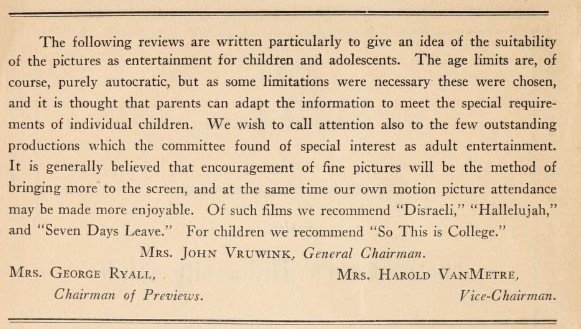
Motion Picture Reviews was one of a handful of small-time publications which reviewed films back in the day. It was issued by the Motion Picture Committee of the Women's University Club, which was the Los Angeles Branch of the American Association of University Women. (Did other branch's around the country issue printed reviews? I don't know.) Well anyways, this slight, unillustrated and rather plain monthly publication was aimed at parents who wanted to know which films were "best" for children. Here is their statement of purpose from their first issue, which is dated January 1930. 

And here is a statement from their third issue, which states that the films they reviewed were shown to them by the Academy of Motion Picture Arts and Sciences courtesy of the Association of Motion Picture Arts and Sciences. All of which suggests that as a group, they had some credibility. 


I read a number of scattered reviews, and must admit that they contain little of interest -- EXCEPT WHEN THEY THREW SOME SHADE,which they occasionally did, as in the write up for The King of Gamblers, shown below. Sounds like a real recommendation to me. Below is a page of reviews from 1930. The review of the Lon Chaney reissue, The Phantom of the Opera, caught my eye. As did the write-up for Playing Around (1930), an Alice White film. It sounds fun. I wonder what they said about Dracula (1931), or Frankenstein (1931). Check out the run of the magazine HERE.

As far as I can tell, the publication ran from 1930 to 1944, which puts it somewhat out of range as far as Louise Brooks' primary career is concerned. But still, I found a few things of interest. Brooks three films from 1931, It Pays to Advertise, God's Gift to Women, and Windy Riley Goes Hollywood, were all covered. It is interesting to me that Brooks was not mention in the piece on Windy Riley; certainly, she was a bigger name than Jack Shutta, who played the title role?

Motion Picture Reviews did not review Brooks' sole 1936 film, Empty Saddles, but they did cover the the two films from 1937 which are part of her filmography, When You're in Love, and The King of Gamblers. The latter is a doozy. BTW, this publication also didn't bother writing up the other Louise Brooks' western, Overland Stage Raiders (1938). Who knows? Perhaps they didn't care for cowboy flicks, or westerns, or serials? Which is odd, because kids sure did.


This blog is authored by Thomas Gladysz, Director of the Louise Brooks Society (www.pandorasbox.com). Original contents copyright © 2022. Further use prohibited.

Saturday, October 16, 2021

More about Louise Brooks in the early 1930s

It is a shame Louise Brooks' career fizzled out in the early 1930s. She could have been a contender.

In early 1930, publications carried stories of Brooks’ return to Hollywood. Behind the scenes, the actress was being courted by Columbia Pictures, where there was talk of a possible role in a Buck Jones western. Brooks, however, refused the part and walked away from a contract with the up-and-coming studio – just as she had done with Paramount in 1928, and American Pathé in 1929. Eventually, she found work in a trio of American talkies released the following year.

Brooks’ career had achieved a momentum which necessitated a strong role in a good film to keep her in the public eye. . . that film might have been the celebrated crime drama, The Public Enemy (1931), if only Brooks had accepted the role offered her by director William Wellman. Instead, what the world got were supporting roles in three lesser films. Each received scant attention and relatively few showings - the most popular and certainly the best of the lot was the slightly suggestive pre-code farce, God's Gift to Women. Nevertheless, it too was a lesser film, and none of the three did anything to help her flagging career. 

Windy Riley Goes Hollywood promo photo

Which again is a shame, because Louise Brooks could have shined in pre-code films. The actress even adapted her look, brushing back her bangs, exposing her forehead, and letting her hair grow just a little bit longer as was the style of the time. 

It Pays to Advertise promo photo

God's Gift to Women promo photo

Following the release of the three films in 1931, Louise Brooks dropped out of Hollywood for what amounted to a five year absence. She declared bankruptcy in 1932, got married and divorced in 1933, worked and toured as a ballroom dancer in 1933 and 1934, and drifted along until 1936, when she played a supporting role in the Buck Jones western, Empty Saddles (Universal). But before that, she was considered for but never offered the title role in The Bride of Frankenstein (1935), James Whale's sequel to his 1931 hit film, Frankenstein. Oh, what might have been. . . . 

Thursday, October 14, 2021

Louise Brooks - Her Last Hurrah in 1931

I recently noticed that the fabulous Media History Digital Library has a bunch of issues of Broadway and Hollywood Movies magazine dating from 1930 through 1934. That's five years worth of this stylish though little known publication. I did my usual search through the magazines, looking for articles or mentions of Louise Brooks, and was a bit surprised by how little press the actress received. Of course, at the time, it was all about Garbo and Dietrich and Mae West and other stars both still remembered and now forgotten. Here is the cover of the February, 1931 issue of the magazine.

Brooks' best year in Broadway and Hollywood Movies was 1931. During the year she was mentioned 3 times, once erroneously, and once not at all when she should have been mentioned. In 1931, Brooks had been absent from Hollywood for nearly two years. She had worked in Europe, and returned to the United States hoping to make a comeback. That year, she appeared in three films, two feature, It Pays to Advertise (Paramount, directed by Frank Tuttle) and God's Gift to Women (Warner Brothers, directed by Michael Curtiz), and a short, Windy Riley Goes Hollywood (Educational, directed by William B. Goodrich aka Roscoe "Fatty" Arbuckle). Each were middling fair at best, and each did nothing to help restart or revive Brooks' flagging career. Brooks was also cast, but walked away from a film which would have helped her career a good deal, William Wellman's The Public Enemy (Warner Brothers).

Brooks' standing in Hollywood is exemplified by these mere mentions in various 1931 issues of  Broadway and Hollywood Movies magazine. In each, she referenced as having appeared in a film. Coincidentally, the write-ups for both God's Gift to Women and Windy Riley Goes Hollywood appeared side-by-side. Considering how concise these write-ups are, it's not surprising that Brooks didn't receive more coverage, especially in regards to Windy Riley Goes Hollywood, in which she is the co-star.

The other film Brooks appeared in in 1931 was It Pays to Advertise. Her role was little more than a brief bit, a five minute cameo at the beginning of the film. (Brooks reportedly played the part to complete her contract with Paramount.) Usually, she was billed fifth or sixth. Truth be told, at the time Brooks was the biggest name in the film; Carole Lombard was at the beginning of her career. However, despite her past fame, her cameo wasn't enough to be mentioned in this short write-up of the film. 


Brooks' one other mention in a 1931 issue of Broadway and Hollywood Movies was for her non- appearance in The Public Enemy. As mentioned, Brooks was cast in the film, and early publicity went out listing her among the cast of this sensational film. (William Wellman Jr, the son of the director and a friend to the Louise Brooks Society, thinks Brooks may have even shot a scene or two before leaving the production - but this has never been confirmed let alone proven.) Somehow, Brooks' name remained associated with the film, for decades to come. And in 1931, Broadway and Hollywood Movies magazine was not alone in mentioning the actress, even though she was far from one of the top billed stars in the film. (I have a thick file of similar erroneous mentions of Brooks' role in the film from film magazines which should have known better to big city newspapers which printed the publicity materials they received.)

And that's it. Brooks' acting career was in steep decline. The only other time she is mentioned in Broadway and Hollywood Movies was on their "Splits and Splices" page in March 1933 in relation to her ex-husband, Eddie Sutherland, who had just remarried.The magazine noted, "Eddie Sutherland is back in L. A. with another wife, his fourth. He flew to Yuma. Ariz., to marry Audrey Henderson, who is not an actress, like his other wives. They were accompanied by Harry Akst, song writer, and Lonnie D’Orsay. Sutherland is a nephew of Thomas Meighan. His former wives were Marjorie Daw, Louise Brooks and Ethel Kenyon. Miss Kenyon, incidentally, was married to Charles Butterworth, actor, in New York,, a few weeks ago." 


Wednesday, May 18, 2016

Rare British clipping - It Pays to Advertise

Here is a rare British clipping I found while in London researching Louise Brooks. This write up of the 1931 comedy It Pays to Advertise comes from The Astorian, which, as far as I can tell, was the official magazine of the Paramount Astorias, which as far as I could tell, were four London theatres named Astoria (the others being Brixton, Old Kent Road and Finsbury Park) taken over by Paramount in 1931. This was back when film studios owned theater chains.


According to this page, It Pays to Advertise was playing at the Brixton Astoria theater commencing the week of December 21st, 1931.

Monday, September 28, 2015

Louise Brooks, product placement, soap, and the 1931 film It Pays to Advertise #3

And here is another newspaper article about the 1931 Louise Brooks' film It Pays to Advertise and the controversy stirred up by the film's prolific use of product placement. The article is in two parts. It concludes (a bit ironically) on the newspaper's page featuring want ads.


Sunday, September 27, 2015

Louise Brooks, product placement, soap, and the 1931 film It Pays to Advertise #2

Yesterday's blog post discussed the 1931 Louise Brooks' film It Pays to Advertise and the controversy stirred up by the film's prolific product placement. The post also discussed the campaign against product placement initiated by Harrison's Reports, a motion picture industry trade journal. Reproduced below is one newspaper editorial about the issue, from an Oregon newspaper.


Saturday, September 26, 2015

Louise Brooks, product placement, soap, and the 1931 film It Pays to Advertise #1

The 1931 film It Pays to Advertise is a farce about rival soap companies, an advertising agency, and a ne’er do-well playboy who attempts to make good. Louise Brooks plays Thelma Temple, a dancer appearing in a musical entitled Girlies Don’t Tell.

It Pays to Advertise was based on a popular stage play of the same name from 1914. Updated and set in the advertising and business worlds, the film referenced a number of actual products and their slogans. As a result, one trade journal took exception.

Harrison’s Reports, which billed itself “a reviewing service free from the influence of film advertising,” objected to product placement in film — be it verbal or visual. Over the course of four months (in articles titled “The Facts About Concealed Advertisements in Paramount Pictures,” “This Paper’s Further Efforts Against ‘Sponsored’ Screen Advertisements,” and “Other Papers That Have Joined the Harrison Crusade Against Unlabelled Screen Advertising”) editor P. S. Harrison railed against this business world farce in particular and product placement in films in general.

Harrison wrote, “The Paramount picture, It Pays to Advertise, is nothing but a billboard of immense size. I have not been able to count all of the nationally advertised articles that are spoken of by the characters.” In the next issue, Harrison stated “In last week’s issue the disclosure was made that in It Pays to Advertise there are more than fifteen advertisements in addition to the main advertisement, '13 Soap Unlucky for Dirt,' which Paramount is accused of having created as a brand for the purpose of selling it.”

Taking the high moral ground, Harrison’s Reports spurred a campaign against “sponsored moving pictures – meaning pictures which contain concealed or open advertising of some one’s product.” Harrison wrote to the studios – and Harrison’s Reports noted that a handful responded with pledges to not include verbal or visual product placement. The crusading editor also wrote to more than 2,000 newspapers, and a number published articles and editorials decrying the practice.

Among those papers that joined Harrison’s cause were four of the New York dailies, the Gannett chain, scores of small town papers, as well as the Denver Post, Detroit Free Press, St. Louis Globe-Democrat, and Tulsa Tribune. The Christian Science Monitor added to the chorus of complaint when it remarked, “Paramount should have been well paid for the large slices of publicity for trade-marked products that are spread all through this artificial story.”

Because of tepid reviews and negative publicity, It Pays to Advertise did poorly at the box office. At best, most exhibitors reported only fair business. In Los Angeles, according to one report, the film “set a new low.”

And what of "13 Soap -- Unlucky for Dirt"? The name of this fictional brand originated with the original story. I don't know that such a brand actually existed at the time the 1931 film was released, but according to news reports from the time (and this could be ballyhoo -- see tomorrow's blog post), an offer of $250,000 was made to secure the trademark for "13 Soap -- Unlucky for Dirt".

Sometime in the last number of years, a company called LUSH manufactured a hand-made soap called "13 Soap -- Unlucky for Dirt". (Unfortunately, this product has since been discontinued.) According to the company's website, the soap was named for the fictitious product in the 1931 film, It Pays to Advertise, starring Carole Lombard, Norman Foster, Skeets Gallagher, and featuring Louise Brooks. Here is a picture of that product, followed by the company description.


Ingredients: Oregano and Rose Petal Infusion (Origanum vulgare and Rosa centifolia), Propylene Glycol, Rapeseed Oil & Sunflower Oil & Coconut Oil (Brassica napus, Helianthus annuus, Cocos nucifera), Water (Aqua), Sodium Lauryl Sulfate, Honey, Perfume, Sodum Hydroxide, Manuka Honey, Sodium Stearate, Oregano Oil (Origanum vulgare), Rose Absolute (Rosa damascena), Geranium Oil (Pelargonium graveolens), Sodium Chloride, Geraniol, *Limonene, Colour 18050.

Lush Times: Our beautiful rose and oregano soap gets its name from a 1931 Hollywood film about a soap company; the son advertised a soap that didn’t exist and demand was so high, the dad had to make it. Sounds like typical Lush, except for the advertising part. Sue from Chelmsford and Dawn from Cambridge had been asked by nurses for an oregano soap because they'd heard that oregano kills MRSA bacteria. (University of the West of England 2008.) This lovely soap has been like gold dust; we adore its translucent loveliness, its scent and its very effective cleansing properties.

Friday, September 25, 2015

It Pays to Advertise

Here is a full page relating to It Pays to Advertise, the 1914 play that became the 1931 film featuring Louise Brooks. Pages similar to this were run in newspapers in 1931, typically groups of smaller ads from local merchants which tied in with the local showing of the Frank Tuttle directed film.


Sunday, November 30, 2008

"It Pays to Advertise" screens in NYC

It Pays to Advertise, a now rarely screened 1931 comedy featuring Louise Brooks, will be shown tomorrow at Film Forum in New York City. Film historian William K. Everson described this film as "A surprisingly sprightly comedy, starting off with a bang and maintaining a much slicker pace than was common in 1930 comedies." Wow! I wish I could be there - as I have never had the chance to see this delightful film on the big screen. And what's more, the copy being shown is a new 35mm print. Show times are at 3:55 and 8:10 pm.


It Pays to Advertise (directed by Frank Tuttle)

"When soap king Eugene Pallette kicks out son Norman Foster for planning to marry secretary Lombard, that’s the last straw—dammit, he’ll get a job! And in the soap business! Then things get sudsier amid clan conniving, business backstabbing, and romantic rhodomontade. With an appearance by silent movie siren Louise Brooks and credits listing "Carol" Lombard."
SUPPORT the LOUISE BROOKS SOCIETY via PAYPAL

Powered By Blogger