Showing posts with label A Social Celebrity. Show all posts

Sunday, March 29, 2026

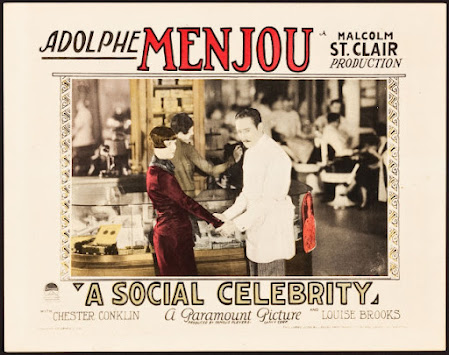
A Social Celebrity, featuring Louise Brooks, was released on this day in 1926

A Social Celebrity, starring Louise Brooks, was released on this day in 1926. The film is a romantic comedy about a small town barber who follows his heart and heads to the big city where he hopes to join high society. Louise Brooks plays the barber’s love interest, a small town manicurist who also heads to the big city to become a dancer. The film is the third in which Brooks appeared, the second for which she received a screen credit, and the first in which she had a starring role. 

More about the film can be found on the newly revised Louise Brooks Society filmography page.

The film was originally set to star Greta Nissen, a Norwegian-born dancer. When she quit the film early in its production, Brooks’ part was rewritten and she took on the role of the female lead. It was a huge break for the 19 year old Brooks and a turning point in her career, as the barber, played by Adolphe Menjou, was one of the biggest stars of the time. In reviewing the film, many critics took special note of Brooks, and thereafter she was regarded as a rising star and someone to watch.

The critic for Exhibitor’s Herald noticed the actress. “Louise Brooks is the third person in the cast. This odd young person who worked with Ford Sterling in that screaming interlude of The American Venus is a positive quantity. She may become a sensational success or a sensational flop, but she is not the kind of player who simply goes along. She’s a manicure girl in this one, later a night club dancer, and she’s unfailingly colorful. I have a personal wager with another member of the staff that she goes up instead of down, both of us agreeing that she’s a moving personality but differing as to direction.” Mae Tinee of the Chicago Tribune also noticed the actress, “Louise Brooks, who plays the small town sweetheart who want to make a peacock out of her razor-bill, is a delightful young person with a lovely, direct gaze, an engaging seriousness, and a sudden, flashing smile that is disarming and winsome. A slim and lissome child, with personality and talent.”

The critic for the Boston Evening Transcript echoed those comments. “In this instance the manicure is no less provocative a morsel than Miss Louise Brooks, remembered for her bit in that specious puff-pastry, The American Venus. Miss Brooks has anything but a rewarding task in A Social Celebrity. Yet it would be ungracious not to comment on the fetching qualities of her screen presence. She affects a straight-line bang across the forehead with distressingly piquant cow-licks over either ear. Her eyes are quick, dark, lustrous. Her nose and mouth share a suspicion of gaminerie. Her gestures are deft and alert — perhaps still a shade self-conscious. In body she is more supple than facial play and her genuflectory exertions in the Charleston might well repay the careful study of amateurs in that delicate exercise.”

A Social Celebrity received many positive reviews, though a few critics thought it too similar to Menjou’s earlier efforts. At it’s New York City premiere, the film proved popular at the 2000 seat Rivoli theater, where it brought it nearly $30,000 during its one week run. (This was at a time when most tickets would have been priced at less than a dollar.) The film critic for the Brooklyn Daily Eagle reported the line for tickets “began at the ticket office and extended to a spot somewhere in the middle of 7th Ave. and 49th St.”

SOME THINGS ABOUT THE FILM YOU MAY NOT KNOW:

— Early on, Paramount promised the up-and-coming Nissen equal billing with Menjou in A Social Celebrity. However, “The temperamental Greta insisted on arriving at the studio one hour late every day,” according to the Brooklyn Norgesposten. Menjou, a major star, was forced to wait for the young actress and complained to director St. Clair. Soon enough, Nissen quit and returned to Broadway to resume her career as a dancer. (The friction caused by Nissen’s departure didn’t seem to spoil a budding romance between the dancer and director — at least not in the short-term. The Brooklyn Norgesposten reported that the couple were frequenting New York’s artists’ clubs. And in early May a Broadway gossip columnist hinted that Nissen might wed the Paramount director.)

— Early scenes set in were actually shot on Long Island in the village of Huntington. The exterior of Spontowiz’s Barber Shop on Main Street, the local trolley line — the Delphi, Indiana, and other aspects of the historic Long Island community were featured in the film. (According to press reports from the time, the film’s director and star spent the better part of two weeks touring Long Island looking for a stand-in for Delphi.)

— To lend verisimilitude, Fred Graff, hairdresser and barber-in-chief at the Paramount Long Island studios, was cast in the film. He can be seen “manipulating the sheers” in scenes shot at the Terminal Barber Shop (located at Broadway and Forty-second Street) in Manhattan.

— Also appearing in a bit part was Agnes Griffith, who won a contest sponsored by Famous Players Lasky and the New York Daily News. This was the first film role for Griffith, a diminutive brunette with a short bob. She later appeared in New York (1927).

— While A Social Celebrity was playing at the Rivoli, Menjou appeared on WGBS, the Gimbel Brothers radio station in NYC. According to newspaper reports, Menjou spoke about the film and the scenes shot locally on Long Island. (If he were to have mentioned his co-star, this broadcast would likely mark the first time Brooks name was mentioned on the radio.)


THE LEGAL STUFF: The Louise Brooks Society™ blog is authored by Thomas Gladysz, Director of the Louise Brooks Society  (www.pandorasbox.com). Original content copyright © 2026. Further unauthorized use prohibited. As an Amazon Associate, I earn from qualifying purchases.  

Monday, December 8, 2025

Searching for the lost films of Louise Brooks

Last week's announcement that Flicker Alley and the San Francisco Film Preserve is set to release Focus on Louise Brooks - a single disc compilation of the surviving material from four Brooks films once considered lost, got me thinking... thinking about which other of Brooks "lost" films I would like to see. What is their status today? What are the chances prints of these films might be found? A fan can hope, can't he?

Screen Test (1925) 

Louise Brooks
In early 1925, Louise Brooks was a featured dancer with the Ziegfeld Follies. The Broadway revue was widely celebrated, and all manner of notables turned out to see shows, with some making a bee-line to the performer’s dressing rooms. Among those who visited Brooks was producer Walter Wanger, then a Paramount talent scout. In late April, Variety reported that Brooks, “one of the most popular members of Louie the 14th” (a Ziegfeld production) had “mysteriously disappeared from the cast of this musical comedy several days ago and her absence has been traced to the scouting agents of a moving picture company with studios on Long Island.”

According to various sources, Wanger had heard Edmund Goulding (the British-born screenwriter and director) rave about Brooks, and so Wanger and Townsend Martin (a Paramount screenwriter and another dressing room visitor) arranged to test Brooks for a role in Herbert Brenon's The Street of Forgotten Men, which was already filming at the Astoria Studios on Long Island. Brooks’ screen test was overseen by famed director Allan Dwan. It went well, with the result being the absent Ziegfeld dancer was assigned a bit part as a moll, the girlfriend / companion to a criminal. Wouldn't it be marvelous to see that screen test?

The American Venus (1926)

This film is presumed mostly lost, though a few bits and pieces were found in the late 1990’s. The surviving material includes fragments, variously in black and white, tinted, and in Technicolor, from two theatrical trailers, as well as fragments from the film itself. Cumulatively, this surviving material — some of which repeats — runs about 8 minutes. The footage from the film includes interior scenes involving Brooks and Ford Sterling and another woman, an outdoor chase scene involving an automobile and a train, and a technicolor sequence of a fashion show. In 2018, the BFI announced they had found a three second piece of Technicolor stock from the film which depicts Louise Brooks. Most all of this material was restored in 2025, and will be seen in Focus on Louise Brooks.

The American Venus is a romantic comedy set against the backdrop of a beauty pageant, namely the actual 1925 Miss America contest in Atlantic City. (The American Venus features the actual Miss America from 1925, Fay Lanphier.) The film is the second in which Brooks appeared, though the first for which she received a screen credit. Brooks made something of a splash, and it was this film and her next, A Social Celebrity, which proved to be her “break-out” roles. Though largely eye-candy and once described as a "flesh show", many fans and at least a few critics responded positively to The American Venus. Wouldn't it be wonderful to see this film in its entirety?

Louise Brooks in The American Venus

A Social Celebrity (1926)

A Social Celebrity is a romantic comedy about a small town barber who follows his heart and heads to the big city where he hopes to join high society. Brooks plays the barber’s love interest, a small town manicurist who also heads to the big city to become a dancer. The film is the third in which Brooks appeared, the second for which she received a screen credit, and the first in which she had a starring role.

This film is presumed lost. Some of it's last known public screenings took place is Asia, in Shanghai in September, 1930 and in Port Moresby, Papua New Guinea in March 1931. According to the Barry Paris biography, Brooks reported seeing the film at the Eastman House in 1957. Lotte Eisner also stated she saw the film, in Paris in 1958, at the Cinémathèque Française. The latter copy was destroyed in a disastrous vault fire in 1959, while the Eastman House copy has since deteriorated. [A mysterious individual named F. Gwynplaine MacIntyre, whose claims could not be verified and were often thought suspect by film historians, once told me that he had seen a deteriorated nitrate print of A Social Celebrity (owned by a private European collector) in the 1990s. MacIntyre died in 2010, and so have his spurious claims that the film has survived.]

Louise Brooks and Adolphe Menjou in A Social Celebrity

Evening Clothes (1927)

Evening Clothes was the first film Louise Brooks made in Hollywood, and at Paramount’s suggestion, the first in which she did not wear her signature bob hairstyle. It's a romantic comedy about a gentleman farmer (played by Adolphe Menjou) who — spurned by his bride, goes to the big city to loose his rustic ways and win back his new wife. Brooks plays Fox Trot, a hot-to-trot Parisian.

This film is presumed lost. Evening Clothes continued to circulate for some four years following its American release. Along with Costa Rica and present day Vietnam, there were also documented screenings in the Australian outback in 1930, and another in New Guinea in September, 1931. 

Adolphe Menjou and Louise Brooks in Evening Clothes

Rolled Stockings (1927)

This film -- one of a number of similarly-themed films aimed toward the youth market of the 1920s -- is presumed lost, which is a shame, as Rolled Stockings (the second film Brooks made on the West Coast) is the only one of Brooks' American silents in which the actress was given top billing. 

As with Evening Clothes, it continued to be shown into the early sound era, with documented screenings taking place overseas in Suriname (August, 1930), Papua New Guinea (October, 1930) and in a tent in Darwin, Australia (October, 1931). Rolled Stockings, along with A Social Celebrity, are the two Brooks films I would most like to see. Who knows, perhaps a print of the film is sitting on a shelf in some far flung place?

James Hall, Louise Brooks, and Richard Arlen in Rolled Stockings

The City Gone Wild (1927)

This early gangster film directed by the noted director James Cruze is presumed lost. In it, Brooks once again plays a moll, this time the deliciously named Snuggles Joy, the “gunman’s honey.” The film was well regarded, and continued to be shown into the early sound era. Documented screenings took place in Fairbanks, Alaska (pre-statehood) and elsewhere around the United States well into 1930. As with Rolled Stockings, the last documented public screening of The City Gone Wild took place at the open air venue known as The Stadium in Darwin, Australia in September 1931. Also showing as part of a double bill was Under the Southern Cross, a New Zealand film with a “purely Maori cast.” 

According to Kevin Brownlow, the film was largely extant as recently as 1971. In his 1990 book, Behind the Mask of Innocence, Brownlow wrote, “David Shepard, then with the American Film Institute’s archive program, had a list of 35mm nitrate prints held in a vault Paramount had forgotten it had. He asked me which title I would select, out of all of them, to look at right away. I said The City Gone Wild. He called Paramount to bring it out of the vaults for our collection that afternoon. The projectionist went to pick it up. ‘O, there was some powder on that,’ said the vault keeper ‘We threw it away.’ The film had been unspooled into a tank of water (recommended procedure for decomposing nitrate). Shepard complained officially to Paramount, who promised it would not happen again. He tried to rescue it, even from its watery grave, but a salvage company had carted it off by the time he got there.” 

This account was confirmed in a conversation I had with David Shepard in June 2016. Shepard recalled that Paramount would, at the time, discard any film which showed any degree of decomposition.

Louise Brooks and Thomas Mieghan in The City Gone Wild

And here are two additional films worth looking for....

Beggars of Life (1928) - the sound version

This outstanding William Wellman directed film was released as both a silent and part sound film; in fact, Beggars of Life is considered Paramount’s first sound film!

The sound version included music, sound effects, a bit of dialogue, and a song reportedly sung by Wallace Beery (either “Hark the Bells” or “Don’t You Hear Them Bells?” or “I Wonder Where She Sits Tonight”). While the silent version is extant -- and has been released on DVD and Blu-ray by Kino Lorber, what's now considered lost are the sound elements. Wouldn't it be remarkable to find / restore the sound version.

The Canary Murder Case (1929) - the silent version

This early murder mystery was also released as both a silent and sound film. The film was initially shot as a silent, and shortly thereafter reworked for sound. Malcolm St. Clair shot the silent version, while retakes for the sound version were directed by Frank Tuttle. Both versions were shown and reviewed at the time of the film's release, and some thought the silent version the better movie.

The sound version of the film is extant. A 35mm print is held at the International Museum of Photography and Film at the George Eastman Museum in Rochester, New York. The print of the "silent version" is also held at the Eastman Museum, but reportedly, this print is only the sound version without sound. Lesser quality prints have been released on VHS and DVD over the years; the best sound version was recently released on Blu-ray by Kino Lorber as part of a Philo Vance set.

THE LEGAL STUFF: The Louise Brooks Society™ blog is authored by Thomas Gladysz, Director of the Louise Brooks Society  (www.pandorasbox.com). Original content copyright © 2025. Further unauthorized use prohibited. As an Amazon Associate, I earn from qualifying purchases.    

Saturday, March 29, 2025

A Social Celebrity, featuring Louise Brooks, was released on this day in 1926

A Social Celebrity, starring Louise Brooks, was released on this day in 1926. The film is a romantic comedy about a small town barber who follows his heart and heads to the big city where he hopes to join high society. Louise Brooks plays the barber’s love interest, a small town manicurist who also heads to the big city to become a dancer. The film is the third in which Brooks appeared, the second for which she received a screen credit, and the first in which she had a starring role. 

More about the film can be found on the newly revised Louise Brooks Society filmography page.

The film was originally set to star Greta Nissen, a Norwegian-born dancer. When she quit the film early in its production, Brooks’ part was rewritten and she took on the role of the female lead. It was a huge break for the 19 year old Brooks and a turning point in her career, as the barber, played by Adolphe Menjou, was one of the biggest stars of the time. In reviewing the film, many critics took special note of Brooks, and thereafter she was regarded as a rising star and someone to watch.

The critic for Exhibitor’s Herald noticed the actress. “Louise Brooks is the third person in the cast. This odd young person who worked with Ford Sterling in that screaming interlude of The American Venus is a positive quantity. She may become a sensational success or a sensational flop, but she is not the kind of player who simply goes along. She’s a manicure girl in this one, later a night club dancer, and she’s unfailingly colorful. I have a personal wager with another member of the staff that she goes up instead of down, both of us agreeing that she’s a moving personality but differing as to direction.” Mae Tinee of the Chicago Tribune also noticed the actress, “Louise Brooks, who plays the small town sweetheart who want to make a peacock out of her razor-bill, is a delightful young person with a lovely, direct gaze, an engaging seriousness, and a sudden, flashing smile that is disarming and winsome. A slim and lissome child, with personality and talent.”

The critic for the Boston Evening Transcript echoed those comments. “In this instance the manicure is no less provocative a morsel than Miss Louise Brooks, remembered for her bit in that specious puff-pastry, The American Venus. Miss Brooks has anything but a rewarding task in A Social Celebrity. Yet it would be ungracious not to comment on the fetching qualities of her screen presence. She affects a straight-line bang across the forehead with distressingly piquant cow-licks over either ear. Her eyes are quick, dark, lustrous. Her nose and mouth share a suspicion of gaminerie. Her gestures are deft and alert — perhaps still a shade self-conscious. In body she is more supple than facial play and her genuflectory exertions in the Charleston might well repay the careful study of amateurs in that delicate exercise.”

A Social Celebrity received many positive reviews, though a few critics thought it too similar to Menjou’s earlier efforts. At it’s New York City premiere, the film proved popular at the 2000 seat Rivoli theater, where it brought it nearly $30,000 during its one week run. (This was at a time when most tickets would have been priced at less than a dollar.) The film critic for the Brooklyn Daily Eagle reported the line for tickets “began at the ticket office and extended to a spot somewhere in the middle of 7th Ave. and 49th St.”


Under its American title, documented screenings of the film took place in Australia (including Tasmania), Bermuda, British Malaysia (Singapore), Canada, China, Hong Kong, Ireland, Jamaica, Japan, New Zealand, Panama, Papua New Guinea, South Africa, Trinidad, and the United Kingdom (England, Isle of Man, Northern Ireland,  Scotland, and Wales). The film was also promoted under the title The Social Celebrity (China & India), and A Sociál Celebrity (Czechoslovakia). In the United States, the film was reviewed as Una Celebridad Social (Spanish-language press).

Elsewhere, A Social Celebrity was shown under the title Au suivant de ces messieurs (Algeria); Figaro en sociedad (Argentina); Der Bubikopfkünstler (Austria); Au suivant de ces Messieurs (Belgium, French) and Aan de Volgende Dezer Heeren (Belgium, Dutch); Desfrutando a alta sociedade (Brazil); Figaro en sociedad (Chile); Un Figaro de Sociedad (Cuba); Sociální osobnost (Czechoslovakia); I laante fjer and Storfyrstinden og hendes kammertjener (Denmark); Au suivant de ces messieurs (Egypt); Parturi frakissa and Frakkipukuinen parturi and Barberaren i frack  (Finland); Au suivant de ces messieurs (France); A Szalon Figáró (Hungary); Un barbiere di qualità (Italy); 三日伯爵 (Japan); Der Liebling der Gesellschaft (Latvia); Der Schaum-Cavalier (Luxembourg); Figaro en sociedad (Mexico); De Dameskapper (Netherlands); Shingle-eksperten (Norway); Disfrutando a Alta Societade (Portugal); Figaro en sociedad (Spain); En Sparv i tranedans (Sweden); Au suivant de ces messieurs (Switzerland); and Au suivant de ces messieurs (French Indochina / present day Vietnam).


  SOME THINGS ABOUT THE FILM YOU MAY NOT KNOW:

— Early on, Paramount promised the up-and-coming Nissen equal billing with Menjou in A Social Celebrity. However, “The temperamental Greta insisted on arriving at the studio one hour late every day,” according to the Brooklyn Norgesposten. Menjou, a major star, was forced to wait for the young actress and complained to director St. Clair. Soon enough, Nissen quit and returned to Broadway to resume her career as a dancer. (The friction caused by Nissen’s departure didn’t seem to spoil a budding romance between the dancer and director — at least not in the short-term. The Brooklyn Norgesposten reported that the couple were frequenting New York’s artists’ clubs. And in early May a Broadway gossip columnist hinted that Nissen might wed the Paramount director.)

— Early scenes set in were actually shot on Long Island in the village of Huntington. The exterior of Spontowiz’s Barber Shop on Main Street, the local trolley line — the Delphi, Indiana, and other aspects of the historic Long Island community were featured in the film. (According to press reports from the time, the film’s director and star spent the better part of two weeks touring Long Island looking for a stand-in for Delphi.)

— To lend verisimilitude, Fred Graff, hairdresser and barber-in-chief at the Paramount Long Island studios, was cast in the film. He can be seen “manipulating the sheers” in scenes shot at the Terminal Barber Shop (located at Broadway and Forty-second Street) in Manhattan.

— Also appearing in a bit part was Agnes Griffith, who won a contest sponsored by Famous Players Lasky and the New York Daily News. This was the first film role for Griffith, a diminutive brunette with a short bob. She later appeared in New York (1927).

— While A Social Celebrity was playing at the Rivoli, Menjou appeared on WGBS, the Gimbel Brothers radio station in NYC. According to newspaper reports, Menjou spoke about the film and the scenes shot locally on Long Island. (If he were to have mentioned his co-star, this broadcast would likely mark the first time Brooks name was mentioned on the radio.)

# # # 

 THE LEGAL STUFF: The Louise Brooks Society™ blog is authored by Thomas Gladysz, Director of the Louise Brooks Society  (www.pandorasbox.com). Original contents copyright © 2025. Further unauthorized use prohibited. As an Amazon Associate, I earn from qualifying purchases.  

Friday, March 29, 2024

A Social Celebrity, featuring Louise Brooks, was released on this day in 1926

A Social Celebrity, starring Louise Brooks, was released on this day in 1926. The film is a romantic comedy about a small town barber who follows his heart and heads to the big city where he hopes to join high society. Louise Brooks plays the barber’s love interest, a small town manicurist who also heads to the big city to become a dancer. The film is the third in which Brooks appeared, the second for which she received a screen credit, and the first in which she had a starring role. More about the film can be found on the Louise Brooks Society filmography page.

The film was originally set to star Greta Nissen, a Norwegian-born dancer. When she quit the film early in its production, Brooks’ part was rewritten and she took on the role of the female lead. It was a huge break for the 19 year old Brooks and a turning point in her career, as the barber, played by Adolphe Menjou, was one of the biggest stars of the time. In reviewing the film, many critics took special note of Brooks, and thereafter she was regarded as a rising star and someone to watch.

The critic for Exhibitor’s Herald noticed the actress. “Louise Brooks is the third person in the cast. This odd young person who worked with Ford Sterling in that screaming interlude of The American Venus is a positive quantity. She may become a sensational success or a sensational flop, but she is not the kind of player who simply goes along. She’s a manicure girl in this one, later a night club dancer, and she’s unfailingly colorful. I have a personal wager with another member of the staff that she goes up instead of down, both of us agreeing that she’s a moving personality but differing as to direction.” Mae Tinee of the Chicago Tribune also noticed the actress, “Louise Brooks, who plays the small town sweetheart who want to make a peacock out of her razor-bill, is a delightful young person with a lovely, direct gaze, an engaging seriousness, and a sudden, flashing smile that is disarming and winsome. A slim and lissome child, with personality and talent.”

The critic for the Boston Evening Transcript echoed those comments. “In this instance the manicure is no less provocative a morsel than Miss Louise Brooks, remembered for her bit in that specious puff-pastry, The American Venus. Miss Brooks has anything but a rewarding task in A Social Celebrity. Yet it would be ungracious not to comment on the fetching qualities of her screen presence. She affects a straight-line bang across the forehead with distressingly piquant cow-licks over either ear. Her eyes are quick, dark, lustrous. Her nose and mouth share a suspicion of gaminerie. Her gestures are deft and alert — perhaps still a shade self-conscious. In body she is more supple than facial play and her genuflectory exertions in the Charleston might well repay the careful study of amateurs in that delicate exercise.”

A Social Celebrity received many positive reviews, though a few critics thought it too similar to Menjou’s earlier efforts. At it’s New York City premiere, the film proved popular at the 2000 seat Rivoli theater, where it brought it nearly $30,000 during its one week run. (This was at a time when most tickets would have been priced at less than a dollar.) The film critic for the Brooklyn Daily Eagle reported the line for tickets “began at the ticket office and extended to a spot somewhere in the middle of 7th Ave. and 49th St.”

Under its American title, documented screenings of the film took place in Australia (including Tasmania), Bermuda, British Malaysia (Singapore), Canada, China, Hong Kong, Ireland, Jamaica, Japan, New Zealand, Panama, Papua New Guinea, South Africa, Trinidad, and the United Kingdom (England, Isle of Man, Northern Ireland,  Scotland, and Wales). The film was also promoted under the title The Social Celebrity (China & India), and A Sociál Celebrity (Czechoslovakia). In the United States, the film was reviewed as Una Celebridad Social (Spanish-language press).

Elsewhere, A Social Celebrity was shown under the title Au suivant de ces messieurs (Algeria); Figaro en sociedad (Argentina); Der Bubikopfkünstler (Austria); Au suivant de ces Messieurs (Belgium, French) and Aan de Volgende Dezer Heeren (Belgium, Dutch); Desfrutando a alta sociedade (Brazil); Figaro en sociedad (Chile); Un Figaro de Sociedad (Cuba); Sociální osobnost (Czechoslovakia); I laante fjer and Storfyrstinden og hendes kammertjener (Denmark); Au suivant de ces messieurs (Egypt); Parturi frakissa and Frakkipukuinen parturi and Barberaren i frack  (Finland); Au suivant de ces messieurs (France); A Szalon Figáró (Hungary); Un barbiere di qualità (Italy); 三日伯爵 (Japan); Der Liebling der Gesellschaft (Latvia); Der Schaum-Cavalier (Luxembourg); Figaro en sociedad (Mexico); De Dameskapper (Netherlands); Shingle-eksperten (Norway); Disfrutando a Alta Societade (Portugal); Figaro en sociedad (Spain); En Sparv i tranedans (Sweden); Au suivant de ces messieurs (Switzerland); and Au suivant de ces messieurs (French Indochina / present day Vietnam).


 SOME THINGS ABOUT THE FILM YOU MAY NOT KNOW:

— Early on, Paramount promised the up-and-coming Nissen equal billing with Menjou in A Social Celebrity. However, “The temperamental Greta insisted on arriving at the studio one hour late every day,” according to the Brooklyn Norgesposten. Menjou, a major star, was forced to wait for the young actress and complained to director St. Clair. Soon enough, Nissen quit and returned to Broadway to resume her career as a dancer. (The friction caused by Nissen’s departure didn’t seem to spoil a budding romance between the dancer and director — at least not in the short-term. The Brooklyn Norgesposten reported that the couple were frequenting New York’s artists’ clubs. And in early May a Broadway gossip columnist hinted that Nissen might wed the Paramount director.)

— Early scenes set in were actually shot on Long Island in the village of . The exterior of Spontowiz’s Barber Shop on Main Street, the local trolley line — the Delphi, Indiana, and other aspects of the historic Long Island community were featured in the film. (According to press reports from the time, the film’s director and star spent the better part of two weeks touring Long Island looking for a stand-in for Delphi.)

— To lend verisimilitude, Fred Graff, hairdresser and barber-in-chief at the Paramount Long Island studios, was cast in the film. He can be seen “manipulating the sheers” in scenes shot at the Terminal Barber Shop (located at Broadway and Forty-second Street) in Manhattan.

— Also appearing in a bit part was Agnes Griffith, who won a contest sponsored by Famous Players Lasky and the New York Daily News. This was the first film role for Griffith, a diminutive brunette with a short bob. She later appeared in New York (1927).

— While A Social Celebrity was playing at the Rivoli, Menjou appeared on WGBS, the Gimbel Brothers radio station in NYC. According to newspaper reports, Menjou spoke about the film and the scenes shot locally on Long Island. (If he were to have mentioned his co-star, this broadcast would likely mark the first time Brooks name was mentioned on the radio.)

THE LEGAL STUFF: The Louise Brooks Society™ blog is authored by Thomas Gladysz, Director of the Louise Brooks Society  (www.pandorasbox.com). Original contents copyright © 2024. Further unauthorized use prohibited. As an Amazon Associate, I earn from qualifying purchases.

Wednesday, March 29, 2023

A Social Celebrity, starring Louise Brooks, was released on this day in 1926

A Social Celebrity, starring Louise Brooks, was released on this day in 1926. The film is a romantic comedy about a small town barber who follows his heart and heads to the big city where he hopes to join high society. Louise Brooks plays the barber’s love interest, a small town manicurist who also heads to the big city to become a dancer. The film is the third in which Brooks appeared, the second for which she received a screen credit, and the first in which she had a starring role. More about the film can be found on the Louise Brooks Society filmography page.

The film was originally set to star Greta Nissen, a Norwegian-born dancer. When she quit the film early in its production, Brooks’ part was rewritten and she took on the role of the female lead. It was a huge break for the 19 year old Brooks and a turning point in her career, as the barber, played by Adolphe Menjou, was one of the biggest stars of the time. In reviewing the film, many critics took special note of Brooks, and thereafter she was regarded as a rising star and someone to watch.

The critic for Exhibitor’s Herald noticed the actress. “Louise Brooks is the third person in the cast. This odd young person who worked with Ford Sterling in that screaming interlude of The American Venus is a positive quantity. She may become a sensational success or a sensational flop, but she is not the kind of player who simply goes along. She’s a manicure girl in this one, later a night club dancer, and she’s unfailingly colorful. I have a personal wager with another member of the staff that she goes up instead of down, both of us agreeing that she’s a moving personality but differing as to direction.” Mae Tinee of the Chicago Tribune also noticed the actress, “Louise Brooks, who plays the small town sweetheart who want to make a peacock out of her razor-bill, is a delightful young person with a lovely, direct gaze, an engaging seriousness, and a sudden, flashing smile that is disarming and winsome. A slim and lissome child, with personality and talent.”

The critic for the Boston Evening Transcript echoed those comments. “In this instance the manicure is no less provocative a morsel than Miss Louise Brooks, remembered for her bit in that specious puff-pastry, The American Venus. Miss Brooks has anything but a rewarding task in A Social Celebrity. Yet it would be ungracious not to comment on the fetching qualities of her screen presence. She affects a straight-line bang across the forehead with distressingly piquant cow-licks over either ear. Her eyes are quick, dark, lustrous. Her nose and mouth share a suspicion of gaminerie. Her gestures are deft and alert — perhaps still a shade self-conscious. In body she is more supple than facial play and her genuflectory exertions in the Charleston might well repay the careful study of amateurs in that delicate exercise.”

A Social Celebrity received many positive reviews, though a few critics thought it too similar to Menjou’s earlier efforts. At it’s New York City premiere, the film proved popular at the 2000 seat Rivoli theater, where it brought it nearly $30,000 during its one week run. (This was at a time when most tickets would have been priced at less than a dollar.) The film critic for the Brooklyn Daily Eagle reported the line for tickets “began at the ticket office and extended to a spot somewhere in the middle of 7th Ave. and 49th St.”


Under its American title, documented screenings of the film took place in Australia (including Tasmania), Bermuda, British Malaysia (Singapore), Canada, China, Hong Kong, Ireland, Jamaica, Japan, New Zealand, Panama, Papua New Guinea, South Africa, Trinidad, and the United Kingdom (England, Isle of Man, Northern Ireland,  Scotland, and Wales). The film was also promoted under the title The Social Celebrity (China & India), and A Sociál Celebrity (Czechoslovakia). In the United States, the film was reviewed as Una Celebridad Social (Spanish-language press).

Elsewhere, A Social Celebrity was shown under the title Au suivant de ces messieurs (Algeria); Figaro en sociedad (Argentina); Der Bubikopfkünstler (Austria); Au suivant de ces Messieurs (Belgium, French) and Aan de Volgende Dezer Heeren (Belgium, Dutch); Desfrutando a alta sociedade (Brazil); Figaro en sociedad (Chile); Un Figaro de Sociedad (Cuba); Sociální osobnost (Czechoslovakia); I laante fjer and Storfyrstinden og hendes kammertjener (Denmark); Au suivant de ces messieurs (Egypt); Parturi frakissa and Frakkipukuinen parturi and Barberaren i frack  (Finland); Au suivant de ces messieurs (France); A Szalon Figáró (Hungary); Un barbiere di qualità (Italy); 三日伯爵 (Japan); Der Liebling der Gesellschaft (Latvia); Der Schaum-Cavalier (Luxembourg); Figaro en sociedad (Mexico); De Dameskapper (Netherlands); Shingle-eksperten (Norway); Disfrutando a Alta Societade (Portugal); Figaro en sociedad (Spain); En Sparv i tranedans (Sweden); Au suivant de ces messieurs (Switzerland); and Au suivant de ces messieurs (French Indochina / present day Vietnam).


SOME THINGS ABOUT THE FILM YOU MAY NOT KNOW:

— Early on, Paramount promised the up-and-coming Nissen equal billing with Menjou in A Social Celebrity. However, “The temperamental Greta insisted on arriving at the studio one hour late every day,” according to the Brooklyn Norgesposten. Menjou, a major star, was forced to wait for the young actress and complained to director St. Clair. Soon enough, Nissen quit and returned to Broadway to resume her career as a dancer. (The friction caused by Nissen’s departure didn’t seem to spoil a budding romance between the dancer and director — at least not in the short-term. The Brooklyn Norgesposten reported that the couple were frequenting New York’s artists’ clubs. And in early May a Broadway gossip columnist hinted that Nissen might wed the Paramount director.)

— Early scenes set in were actually shot on Long Island in the village of . The exterior of Spontowiz’s Barber Shop on Main Street, the local trolley line — the Delphi, Indiana, and other aspects of the historic Long Island community were featured in the film. (According to press reports from the time, the film’s director and star spent the better part of two weeks touring Long Island looking for a stand-in for Delphi.)

— To lend verisimilitude, Fred Graff, hairdresser and barber-in-chief at the Paramount Long Island studios, was cast in the film. He can be seen “manipulating the sheers” in scenes shot at the Terminal Barber Shop (located at Broadway and Forty-second Street) in Manhattan.

— Also appearing in a bit part was Agnes Griffith, who won a contest sponsored by Famous Players Lasky and the New York Daily News. This was the first film role for Griffith, a diminutive brunette with a short bob. She later appeared in New York (1927).

— While A Social Celebrity was playing at the Rivoli, Menjou appeared on WGBS, the Gimbel Brothers radio station in NYC. According to newspaper reports, Menjou spoke about the film and the scenes shot locally on Long Island. (If he were to have mentioned his co-star, this broadcast would likely mark the first time Brooks name was mentioned on the radio.)

THE LEGAL STUFF: The Louise Brooks Society™ blog is authored by Thomas Gladysz, Director of the Louise Brooks Society  (www.pandorasbox.com). Original contents copyright © 2023. Further unauthorized use prohibited.

Monday, February 25, 2019

Last night I had the strangest dream I ever dreamed before

I have been working day and night on my latest book project, Around the World with Louise Brooks: the making of an international star. And as of today, I have nearly 550 pages completed, and hope to have the book finished in a few months. Perhaps because I have been so focused on this project, last night I had the strangest dream I ever dreamed before.

Onchi Koshiro "Movie Theater (Hogaku-za)" 1929 *

I dreamed I was at a screening of the lost Louise Brooks' film A Social Celebrity (1926). Since it is lost, no one today really knows what the film "looked like." But there I was in my dream, viewing whole scenes and anxiously wondering how to record what I had seen. What was this dream, this fevered pitch? Was A Social Celebrity somehow transmitted to me through our collective unconsciousness and through time? If so, who sent this dream to me?


A street scene is vivid in memory, though I don't know that there is any sort of street scene in that particular film. There is such a scene in The Street of Forgotten Men (1925), and perhaps in my dream logic I was conflating the two early Brooks' movies. I have seen that earlier film, and recently came across a remarkable foreign clipping depicting a production still (depicting a street) taken during the making of The Street of Forgotten Men. Below is that production shot. I wonder who the solitary, short haired young women might be in the lower center of the image? Standing apart, day dreaming....


* The print shown above was made by the Japanese artist Onchi Koshiro. It depicts a woman on a movie screen inside the Hogaku-za movie theatre in Toyko. The work is dated 1929, the same year that The Canary Murder Case was shown to great acclaim in that very theatre. Koshiro once said "Art is not to be understood by the mind but by the heart." I think the same can be said for dreams.

Saturday, November 5, 2016

Louise Brooks, at the corner of Brooklyn Avenue and 16th Street

In the 1920s, movies were advertised in all manner of ways -- in newspapers and magazines, on posters and handbills, in window displays, and even by individuals walking down the street wearing a sandwich boards. And like today, they were also advertised on billboards.

In the past, I have seen only one image of the billboard promoting a Louise Brooks' film, namely The Canary Murder Case, as it appeared in a distant and grainy photograph in a Winnipeg, Manitoba newspaper.

Recently, I came across something very special -- a photograph of a billboard promoting A Social Celebrity in Kansas City, Missouri. To me, it is a remarkable image, as it is not in a downtown setting (as in the Canary Murder Case image I had seen), but rather, in a city neighborhood. What's more, I found the image on an African-American history website -- the Black Archives of mid-America, which leads me to guess but not know for sure that the neighborhoods depicted below were African American neighborhoods. [It's not surprising that Brooks films were advertised in Black neighborhoods. In fact, I have come across a handful of instances when Brooks films were shown in theaters that catered to African Americans, one in Harlem, and one in Baltimore.]

Here is the first image I found, followed by a close-up of the billboard itself.


The billboard depicted above promotes a showing of A Social Celebrity at the downtown Newman Theater in Kansas City, commencing the week of May 1. One might ask, "Why was this picture taken?" Most likely, I would guess, to prove to Paramount or the film's local distributor or exhibitor that the film was in fact advertised as per an agreement.

I also happened to come upon another photograph from the time (all of which were credited to the Merritt Outdoor Advertising Co.) which depicts another billboard promoting A Social Celebrity in Kansas City! It's the on the far right. This photo is set at Broadway and 35th Street.


Just as I began to wonder it there had been a city wide campaign to promote the film, I came across another image of a billboard promoting A Social Celebrity. This one located at 15th and Holmes Streets in Kansas City.


And here is another, where the billboard is on the left of the three billboard construct. This picture was shot 4025 Troost Avenue.


I found four more images of billboards promoting A Social Celebrity, including the picture below. Unfortunately, this photograph, which is typical of the others, shows the billboard either distant or obscured (here behind a tree at the corner of Independence Avenue and Maple Boulevard). Nevertheless, that makes eight photographs of eight billboards promoting the same showing of A Social Celebrity.


Incidentally, the Newman showed many of Brooks' films when they were first released. The Newman was a major first run theater in a major metropolitan area. In fact, it was the "largest motion picture theater to be built in the downtown district and the most costly theater of any sort" erected at the time in Kansas City. Seating capacity was 2,000. There was also a big organ installed.

Named after Frank L. Newman and opened in 1919, the Newman theater was later sold to and operated by Paramount Pictures starting in 1925, when Newman left to manage theaters in Los Angeles for the Famous Players-Lasky Film Corporation. After another change of name and a renovation in 1969, the theater was closed for good and demolished in 1972. Here is a vintage postcard view of the theater.


These historic billboard images got me wondering. If they exist for one film in one city, where are others like them from other major cities? The search continues....

I wasn't able to find much about Frank Cambria's Garden Festival, which was the opening act for A Social Celebrity at the Newman in Kansas City. Seemingly, he/it was a traveling act, turning up in 1926 in Buffalo, Detroit, St. Louis and elsewhere. When Cambria's Garden Festival was staged that same year in Brooklyn ahead of the Richard Dix's film, Let's Get Married, the Brooklyn Daily Eagle described it as "a lovely presentation, staged in good taste and has as its theme song Schubert's Serenade."

Incidentally, I did find a few other images depicting billboards for other films starring the likes of Norma Shearer, Zasu Pitts, Helen Chadwick and others. Here is one of them, for the Priscilla Dean, Lon Chaney film Outside the Law at the Liberty theater. (Another image I came across, of a four billboard construct, depicts both Outside the Law and A Social Celebrity. That image is the fourth image from the top, though the billboard for Outside the Law is a hard to make out.)


Saturday, March 29, 2014

A Social Celebrity - A Round-up of Reviews

A Social Celebrity, Louise Brooks' third film, was officially released on this day in 1926. The film is a comedy about a small town barber's son who poses his way into New York high society. This Paramount film was directed by Malcolm St. Clair. Adolphe Menjou played Max Haber, Louise Brooks played Kitty Laverne, and Chester Conklin was Johann Haber. The film is lost.


A Social Celebrity proved popular. Here is a round up of magazine and newspaper reviews and articles drawn from the Louise Brooks Society archive.

Marzoni, Pettersen. "Picture Reviews." Birmingham Age, March 29, 1926.
--- "A newcomer also provides color to A Social Celebrity. She is Louise Brooks, who flashed a moment of inspiration in The American Venus." (brief review in Birmingham, Alabama newspaper; the film was also deemed acceptable by the Better Films Committee of Birmingham in an adjunct column)

Tinee, Mae. "Adolphe Menjou Proves He's No One Role Actor." Chicago Tribune, March 31, 1926.
--- "Louise Brooks, who plays the small town sweetheart who want to make a peacock out of her razorbill, is a delightful young person with a lovely, direct gaze, an engaging seriousness, and a sudden, flashing smile that is disarming and winsome. A slim and lissome child, with personality and talent."

Hughston, Josephine. "Adolphe Menjou At Liberty in A Social Celebrity." San Jose Mercury Herald, April 2, 1926.
--- "Louise Brooks is Kitty, the girl who sets the pace in leaving the small town to dance in a New York night club."

anonymous. "A Social Celebrity." New York Morning Telegraph, April 19, 1926.
--- "Besides Menjou's capital performance, various rosettes and medals should go to Josephine Drake, Louise Brooks, Chester Conklin and Elsie Lawson. . . . Louise Brooks, provocative, alluring, would have been enhanced by better lighting or darker make-up, but that will doubtless come in another picture. She is, Heaven knows, potent enough as it is."

W., M. "Mr. Menjou in Another Cinema Joy on Valentine Silver Sheet." Toledo Times, April 19, 1926.
--- "Louise Brooks, who left Mr. Ziegfield's 'Follies' for a career on the shadow stage, has her first important role opposite him and does admirably. She is a captivating little brunette with the figure of a Venus."

McGowen, Rose. "Social Celebrity Shaved Off Nobility by Chance Remark." New York Daily News, April 20, 1926.
--- "Louise Brooks would have been ample excuse for making any picture. Here is a young actress who has fresh young beauty reinforced by one of the most expressive faces I have ever seen on the screen."

Pelswick, Rose. "New Pictures on Broadway." New York Evening Journal, April 20, 1926.
--- "It is about 85 per cent top grade entertainment and consequently much better than the average. . . . Louise Brooks is an unusually attractive girl who stirs the hero to ambition by leaving the same small town to do the inevitable Charleston in a Broadway night club."

Fred. "A Social Celebrity." Variety, April 21, 1926.
--- "And in Louise Brooks it looks as though Famous has a find that might rank in the Colleen Moore class providing they handle her right."

anonymous. "Adolphe Menjou in A Social Celebrity." Film Daily, April 25, 1926.
--- "Louise Brooks a cutey and with a quantity of good looks. She isn't exactly the heroine type though. She would make a far better baby vamp."

Montfort, Lawrence M. "Menjou Funny in Granada's Screen Farce." San Francisco Illustrated Daily News, April 26, 1926.
--- "Louise Brooks, who plays the small town girl who coaxes Menjou to emulate her example and try luck in New York is a comer and awfully good to look upon. Her straight-cut bob, black eyes and not too sweetly pretty face are different, and she displays some acting ability."

B., D. W. "Films of the Week." Boston Evening Transcript, April 28, 1926.
--- "In this instance the manicurist is no less provocative a morsel than Miss Miss Louise Brooks, remembered for her bit in that specious puff-pastry, The American Venus. Miss Brooks has anything but a rewarding task in A Social Celebrity. Yet it would be ungracious not to comment on the fetching qualities of her screen presence. She affects a straight-line bang across the forehead with distressingly piquant cow-licks over either ear. Her eyes are quick, dark, lustrous. Her nose and mouth share a suspicion of gaminerie. Her gestures are deft and alert - perhaps still a shade self-conscious. In body she is more supple than facial play and her genuflectory exertions in the Charleston might well repay the careful study of amateurs in that delicate exercise."

anonymous. "Menjou, Heart Breaker, Tries Hand at Barbering." Portland Oregonian, May 11, 1926.
--- "It introduces to the movie public a new heroine in the person of the sleek and boyish Louise Brooks. A little young, perhaps, but buoyant and of most engaging smile. There is no opportunity to learn whether or not she can act, but in her role of chorus girl she reveals the most beautiful pair of legs in the movies - which is a rather broad statement and a comment which would have been in very poor taste in crinoline days."

anonymous. "The Screen in Review: A Barber-shop Chord." Picture-Play, August, 1926.
-- "Louise Brooks is the young lady with the black hair who saved The American Venus from a fate worse than death. This young lady, very recently from Kansas, is the newest of all those new faces that have been cropping up lately. And the prettiest, too."

Thursday, March 27, 2014

Day 2: The Diary of a Social Celebrity features Louise Brooks


According to the movie herald pictured above and below, March 27th is day two in the diary of a social celebrity - "a bobbed hair barber who bobbed up at the right time." The film it promotes, A Social Celebrity, which starred Adolphe Menjou (as "social celebrity" Max Haber) and Louise Brooks (as Kitty Laverne), was officially released on March 29th, 1926. (A round-up of reviews will run on this blog in two days. Please check back.) In the meantime, here is the Paramount herald for the film.

Monday, September 13, 2010

An Encounter with F. Gwynplaine MacIntyre

In June, the 59 year old writer F. Gwynplaine MacIntyre took his own life. He set his book and paper-filled New York City apartment on fire and died in the resulting blaze. It was an ugly ending to what was certainly a sad, even tormented life. On Sunday, the New York Times ran a long article on the enigmatic, Scottish-born author.

Little is known about him, except that at one point, in order to escape his troubled past, he changed his name to "Fergus MacIntyre." According to Wikipedia, the allusive author acknowledged he took the middle-name of "Gwynplaine" from the protagonist of The Man Who Laughs, the memorable novel by Victor Hugo turned into an equally memorable 1928 film starring Conrad Veidt. In those works, Gwynplaine was the disfigured, always smiling malcontent who later inspired “The Joker” character in Batman.

MacIntyre was best known as a genre author whose sporadic output included science fiction, fantasy, horror, and mystery stories as well as a science fiction novel and a book of light verse and humorous pieces once praised by Isaac Asimov and Ray Bradbury. Reportedly, a number of unpublished manuscripts were burned in his apartment fire.

MacIntyre also authored newspaper articles and book reviews, and ghost authored and contributed to other works. According to Wikipedia, MacIntyre “contributed substantial script material” to a 2006 documentary on the silent film actress Theda Bara, The Woman with the Hungry Eyes. It was directed by Hugh Munro Neely, who also directed Louise Brooks: Looking for Lulu.

MacIntyre’s reputation in the film community (which is curiously not addressed in the New York Times article) rests on his having written reviews of lost films which he sometimes claimed to have only recently seen. These reviews appeared on IMDb and film message boards, where they live-on to this day.

Such claims, made convincing through MacIntyre’s skills as a writer, drove film historians to distraction. To many in the online film community, he was little more than a prankster playing with the facts while playing a joke on serious film enthusiasts. MacIntyre's claim to have seen various lost films included at least one featuring Louise Brooks, A Social Celebrity (1926).


In the spring of 2006, I emailed MacIntyre regarding his 2002 IMDb review of that lost Brooks film. Not then knowing his reputation, I wrote “I am preparing a book on the films of Louise Brooks, and noticed your thoughtful comments on A Social Celebrity on the IMDB website. I am wondering if you ever saw the film? (The last known copy of A Social Celebrity was lost in a disastrous nitrate fire at the Cinémathèque Française in the late 1950s.) If you have in fact seen the film, I would be very curious to know when and where.”

MacIntyre responded the next day.
Greetings to Thomas Gladysz (do you pronounce it Gladdish?) from Fergus (F. Gwynplaine) MacIntyre, whom you contacted regarding the film A Social Celebrity.

Although I've read your IMDb review of Looking for Lulu, and your email address is an obvious tribute to Brooks, I'm surprised to learn that you're writing a book about her. Surely every possible fact about Louise Brooks has long since been unearthed?

I wish you good luck with your book, and I encourage you to avoid the cliche which several other authors (including Brooks herself) have perpetrated when writing about her: please do not refer to Brooks as 'Lulu'. Lulu was one of the characters she played onscreen. Louise Brooks was a far more fascinating and complex person than Lulu was.

To answer your question: yes, I have seen a print of A Social Celebrity. It was a 'flash print', meaning that it possessed the original (Paramount) intertitles, but they ran for only a few frames each; the print was intended for distribution in a non-Anglophone market, and the local exhibitor was supposed to use the flash titles as a guide for translations, which would occupy more footage than the flash versions and be onscreen longer. I viewed this print more than ten years ago, and it was already slightly deteriorated due to nitrate instability.

This print is (or was) in the personal collection of a private film collector in Europe, who does not wish to be publicly identified. He owns several original nitrate prints of films that were released in the 1930s and earlier. I was given some limited access to some of the films in his collection, solely in order to examine their physical deterioration, and to advise him as to which reels of film in his collection were most urgently in need of restoration or duplication to acetate safety stock.

Normally, when a reel of film has deteriorated to the point where I'm unwilling to subject it to the vagaries of a motorised projector, I will inspect the footage through a hand-held Steenbeck viewer. Several reels of the Social Celebrity print had begun to decompose, so I Steenbecked them rather than running them through a projector.

I have offered to put this collector into contact with several professional film restorers in Europe and Britain, and it is my understanding that he will eventually have most of the nitrate films in his collection converted to acetate stock. I have very little ability to influence his actions in this matter.

This collector is a private individual who only very rarely grants access to his film collection. I was given very limited access to his collection, solely in order to inspect his films as physical artefacts in need of restoration. I do not have direct contact with this gentleman; I contact him only through his attorneys, who are strongly inclined to refuse all requests for access to his collection. He has made it clear that he will not grant public access to his collection. As this gentleman has been helpful to me in my own business endeavours, I must respect his privacy.

Thank you for reading my IMDb reviews. I'm not an employee of IMDb, and they don't pay me for my reviews. I'm a full-time journalist and author. If you log onto www.amazon.com and go to their Books section, then key a search for my by-line "F. Gwynplaine MacIntyre", you'll see the covers of two books that I wrote and illustrated. One of these is my Victorian erotic horror/romance novel: The Woman Between the Worlds, featuring Conan Doyle, Aleister Crowley, GB Shaw, WB Yeats, Arthur Machen, Sir William Crookes and several other eminent Victorians united to aid an invisible she-alien during an invasion of London by alien shape-changers. This novel got rave reviews from Harlan Ellison on his Stateside cable-tv show. I'm also the author and illustrator of a humour anthology which was praised by Ray Bradbury and other authors: MacIntyre's Improbable Bestiary, likewise available on Amazon, which contains some original material I wrote about Lon Chaney and silent films.

To whet your appetite, here's the cover (my artwork and typography) of my anthology: http://images.amazon.com/images/P/1587154722.01.LZZZZZZZ.jpg

I took some notes while I was Steenbecking A Social Celebrity. If you have any specific questions about the content of this film, I will gladly try to answer them for you, but I must decline any request to give you access to the print.

Straight on till mourning, Fergus (F. Gwynplaine MacIntyre)
Could it be true? I wondered. In my naiveté, I hoped it would be. I responded immediately and pressed MacIntyre for details, sent him specific questions, but didn’t hear back. I am sure I came off as too eager, and MacIntyre wasn’t willing to go extra innings.

A few days later, I wrote MacIntyre again. “I am not sure you received my email. I am glad to know that a copy of A Social Celebrity still exists in some form - even if that copy is unattainable - and may one day be given to a public archive. I shall await that day!” I never heard from him again. And as time passed, I began to feel this curious character with unsubstantiated claims had been pulling my leg.

The New York Times noted MacIntyre worked night jobs in order to spend his days at the New York Public Library researching things which interested him. Those subjects included early film, of which he was by all accounts knowledgeable. Undoubtedly, he relished their depictions of days gone by – and of a world, made safe through the passage of time, which no longer existed.

MacIntyre was something of a pastiche artist - witness his own description of his sole published novel. To me, his reviews of silent films he couldn’t have seen read like a kind-of critical pastiche of reviews found in the old film periodicals housed at the New York Public Library. That occurs to me now when I reread his IMDb review of A Social Celebrity. Its last line, “Louise Brooks is as seductive as usual, but she has very little to do here,” echoes the kind of observation made by a number of film critics in the 1920’s.

It’s hard to know why MacIntyre claimed to have seen A Social Celebrity and other lost films – and thereby muddied the historical record. He must have known it irritated others. Perhaps it was a game. Perhaps it was one way of getting attention. Perhaps it was his way of asserting control over a world in which he felt increasingly out-of-sorts. We’ll never know.

MacIntyre was an enigmatic, intellectual loner. He once wrote, “I collect the fragments of time that other people throw away, and I put these to good use.” Not everyone agreed.
SUPPORT the LOUISE BROOKS SOCIETY via PAYPAL

Powered By Blogger